Showing posts with label Mexican Spotted Owl. Show all posts

Sunday, January 1, 2017

The Return to Slate Creek

Hey Readers!


Happy 2017!  In this post, I return to the Slate Creek Divide - a little-known birding spot at the furthest reaches and highest elevations in Maricopa County.  Tommy DeBardeleben, Caleb Strand, and I were going to attempt something that likely no one has ever done at this location.  We were going to hike into the drainage at night and search for owls - a risky undertaking.  As a birder who highly regards birding in his home county, I was absolutely thrilled to be able to return to this location.  My last trip to Slate Creek was, without doubt, the best high elevation Maricopa County birding trip I've experienced up until this point.  Many high-elevation species that have limited ranges in Maricopa County can be found at Slate Creek.

Tommy and Caleb arrived at my house the afternoon of the day we were leaving.  We were super excited for the possibilities we had in store!  We picked up some pizzas en route (Hail Little Caesar's!).  It was awesome to be able to talk and joke with Caleb and Tommy again; they're fun to be around.  After traveling north on the Beeline Highway and taking the exit towards Slate Creek, we began gaining some elevation.  Instead of Sonoran desert, we were surrounded by chaparral; a habitat that is comprised of dense shrubbery that covers sloping foothills.  We began to note typical chaparral species such as Woodhouse's Scrub Jays, Bewick's Wrens, Blue-gray Gnatcatchers, Canyon Towhees, a Rufous-crowned Sparrow, many Spotted Towhees and also a pair of Western Tanagers.

As we rounded a corner, I saw a long tail waving around at the side of the road.  I was shocked to find that it belonged to a White-nosed Coati!  The coati quickly dissapeared into the dense chaparral before any photos could be taken.  I was absolutely ecstatic that we had found one; it was the best mammal I had seen all year.  It never had occurred to me that they could be found so far north in the state.  In Arizona, they are most often found in the "Sky Island" mountains in the southeast corner of the state.  Once we arrived at Mt. Peeley Trailhead, we parked at our campsite and quickly geared up because we wanted to get down into the drainage before dark.


Caleb checking out some Broad-tailed Hummingbirds...

We found some good birds both at the trailhead and in the drainage before dark.  An Ash-throated Flycatcher, some Mexican Jays, a couple Bridled Titmice, some Brown Creepers, Painted Redstarts, a Lark Sparrow, and four Hepatic Tanagers were my favorites.  On our way to The Intersection (an area where two drainages meet and a possible breeding location for Mexican Whippoorwills), I noticed some whitewash on the ground under a sycamore and looked up...


A fledgling Mexican Spotted Owl looks down at me from its cozy perch


Immediately after I had located the bird, Tommy and Caleb were on it.  We all just stood there taking photos and admiring the incredible creature before us.

We walked around the owl and then climbed high enough to see it at eye level.

After taking photos, we carefully walked away...
After this encounter, we reached the confluence of the drainages.  Although we listened intently for Mexican Whippoorwills, none could be found.  We did hear a Common Poorwill however.  As we marched along in the dark with dim headlamps lighting the rocky ground before us, a resonant "Hu!  Hu-Hu! Huaww!" sounded off.  It was a Mexican Spotted Owl's song!  I had never heard the species' song before, so naturally, I was excited.  The owl was pretty far from us, so we decided against trying to locate it.  It was getting pretty late by this time so we began our ascent out of the drainage.  Walking over rocky terrain in the dead of night had its challenges.  Luckily, we didn't stumble across any rattlesnakes or bears!  Once we made it back to the trailhead, we continued our search for owls...

A male Windscorpion
A female Windscorpion

A mysterious katydid that even BugGuide.com hasn't been able to ID...

Possibly Shizocosa avida
From the Gila County side of the main road, we faintly heard a Flammulated Owl giving its deep hooting calls!  It was quite distant and the terrain was sketchy, so we didn't try to find it.  Another Common Poorwill surprised us as it flew across the road right in front of us.  At this point, it was late and we knew that we needed some sleep if we wanted to get an early start the next day.  Since we didn't want to bother with putting up tents at this point, we just slept on the ground... under a sky full of stars.  It wasn't very cold, so we were quite comfortable.  As we were settling in, another Flammulated Owl began calling from the mountainside behind us!  This one was my first for Maricopa county; a perfect example of a species with a limited range in Maricopa Co.  I fell asleep that night listening to the drone of crickets and the distant calls of that Flammulated Owl.  This experience is among my favorites from Slate Creek.  

Waking up around 5:30 am, we shook off our dusty sleeping bags and enjoyed some cold pizza before heading into the same drainage we explored the night before.  One of the first species we encountered was my Maricopa County first Mountain Chickadee!  We also saw a few migrant Rufous Hummingbirds.  


Good to see this little guy again!

You know that situation when you're watching cute bear cubs and you forget what could be right behind you?  

Well...


The fledgling's observant parent

Acorn Woodpeckers, White-throated Swifts, Red-breasted Nuthatches, Blue-gray Gnatcatchers and Painted Redstarts were present in good numbers.  Species found in low numbers included Black Phoebes, Hutton's Vireos, Brown Creepers, Western Tanagers and Scott's Orioles.  At "The Intersection" which we visited the night before, we found the local Dusky-capped Flycatchers!

     
The slender profile of a Dusky-capped Flycatcher

The Intersection
A net-winged beetle; probably Lycus fernandezi

A striking male Western Tanager

This "Spruce" Red Squirrel was a nice addition to my Maricopa County mammals list

After our short stop at The Intersection, we headed back up towards the trailhead using a different route.  It was good to cover new habitat and the potential for something new was exciting!  On our way to the top, we encountered several Western-type flycatchers.  We were able to pick out a Cordilleran by voice!  A new county addition for me.  


One of several Hepatic Tanagers we encountered

As we approached the trail, Tommy shouted back to Caleb and I: "Golden Eagle!"  Moments later, the large, dark raptor soared low above our heads past a small opening in the canopy!  We were all excited to see such a powerful and iconic bird in Maricopa county.  


Trail in sight...

Our view of the Slate Creek Divide from the trail


Back at the car, as we were packing up, we heard the most peculiar sound.  It was a doubled whistle with an eerie quality.  We were all at a loss as to its identity but thought it could potentially be an uncommon call from either a Steller's Jay or Scott's Oriole.  However, to this day, even after studying the vocal repertoires of many possible species, I haven't found out what made those calls.  I consider it to be one of my greatest birding mysteries.  After safely making our way off the mountain, we stopped for some burgers in Phoenix and decided to stop at the Glendale Recharge Ponds; one of Tommy's favorite spots.  The GRPs are excellent for waterfowl, shorebirds, gulls and a good selection of open-country birds.  
        
The shallow water here attracts a multitude of birds that search for invertebrates in the mud...

...as well as the predators that hunt them.  

Of particular interest was this lone Semipalmated Plover: 


Although reminiscent of the more common Killdeer, the Semipalmated Plover is smaller and daintier with a black tipped orange bill, single black breast band and different head pattern.  A single Gadwall and Bald Eagle were also good to see.  The Golden Eagle from earlier in the day gave up its position as last Maricopa lifer of the trip when two Bank Swallows zipped across the pond!  I had never seen a Bank Swallow before, so it was important that I study them as long as they were in sight; which wasn't long. 

Here, Caleb blends in with some weeds at the GRPs
Although it was 6 pm by the time we left Glendale and we were pretty wiped out from or long day, we were still motivated to find new birds.  We headed off towards the spot along Arlington Road where a vagrant Hudsonian Godwit had been staked out to scan the pond for other shorebirds (we had all seen seen the godwit before today, so it wasn't our primary focus).  Much to our delight, the Hudsonian Godwit was still there and so were a wide range of shorebirds; these being Least and Western Sandpipers, Long-billed Dowitchers, Wilson's Phalaropes and my first-for-Maricopa Stilt Sandpiper!            

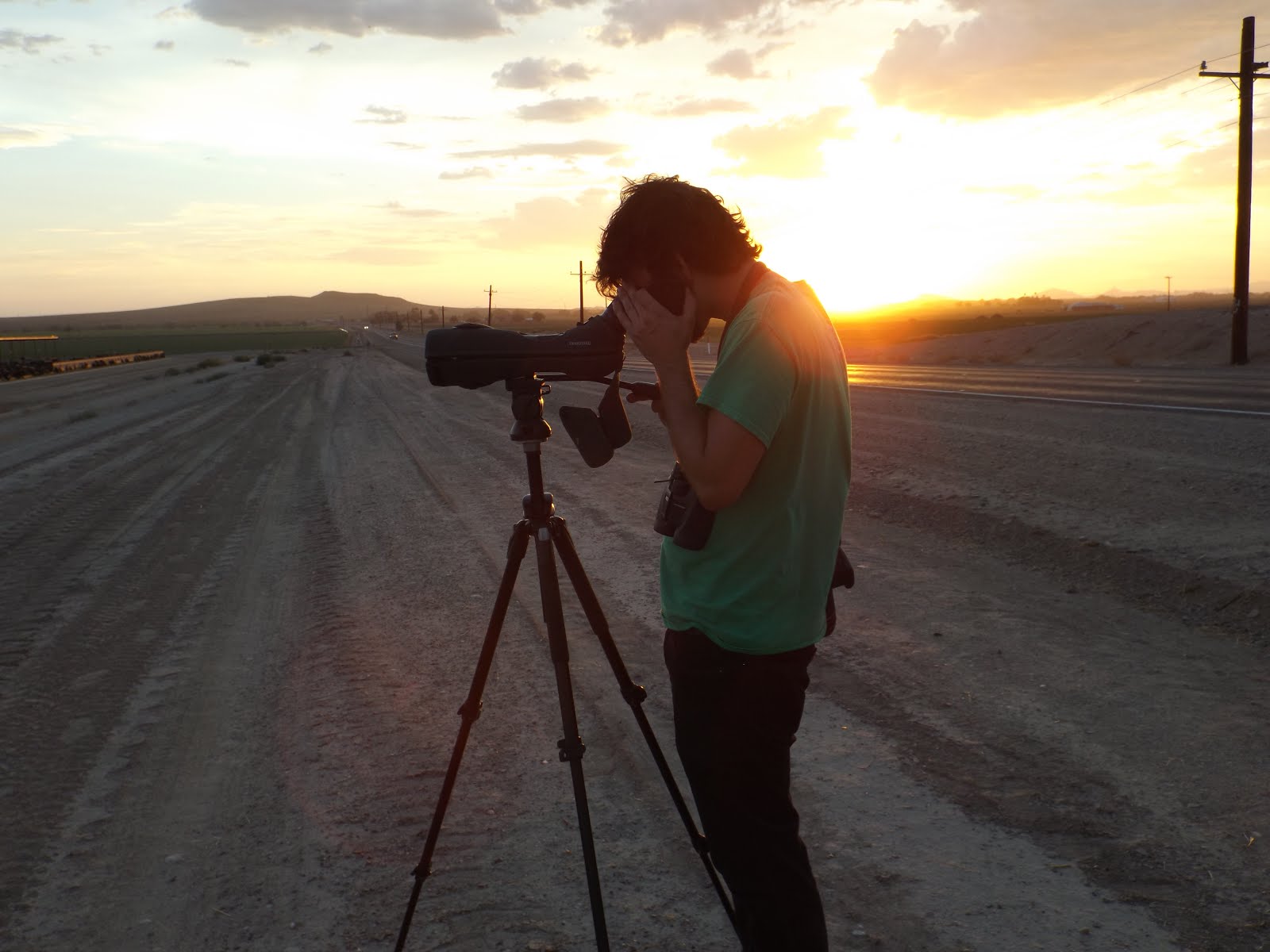
Tommy patiently scans the distant pond

One of Arizona's many smog-free sunsets

With the setting of the sun, our time birding came to a close.  Tommy and Caleb never neglected to share their knowledge with me and I really felt that I grew in my understanding of higher-elevation birds during this trip.  Slate Creek is a place to which I would return in a heartbeat.  My next post will take me to a corner of the state I never expected to visit with birds I never expected to see!

Godspeed and good birding,

- Joshua

Thursday, July 14, 2016

Through The Portal: Day 2

Hey Readers!


Last time on Adam's Command:

Caleb and Joshua meet fellow young birder Dorian and begin an epic quest for birds in the fabled Chiricahua Mountains of Southeast Arizona...  At the Young Birder's Camp, Joshua find 9 lifers before the night is over and also enjoys the local mammals and arthropods...


I hear talking and my eyes open.  Caleb is telling me to wake up, but I'm still pretty tired and feel like I only slept for three hours.  Oh, that's right.  I did only sleep for 3 hours. We all begin walking along the main trail and stopped to listen - trying to ignore the constant snory trills of Mexican Spadefoots around us.  We hear Whiskered Screech Owls right off.  But there were two!  And they were dueting with their bizarre morse code calls.


While we were watching the Whiskereds, a Western Screech Owl and Elf owl started calling!  Then, we heard a very strange whistling sound.  I had no clue what it was, but Caleb knew.  It was a female Spotted Owl's contact call.  I was amazed to hear this owl for the first time.  We also started hearing Mexican Whippoorwills and Brown-crested flycatchers around that time.  We made a pit stop at camp and I found some more interesting bugs.  


A Sexton Beetle that is carrying tiny nymphs on its back.

A Short-horned Walkingstick

Moving on to the forest around camp, we had Wild Turkeys, Cordilleran Flycatchers, 4 Buff-breasted Flycatchers, Bushtits, an "albescens" Brown Creeper (a potential split), Hermit Thrushes, a Yellow-eyed Junco, a Western Tanager and more.


We often would stop to listen (a good practice to adopt) and at one such pause, we heard a barking sound in the distance.  It immediately hit me that I was hearing my first ever Elegant Trogon!  We followed the sound and found the bird - a male - in a sycamore dominated riparian area.  It was epic.


After we enjoyed our special time with the trogon, Caleb ran back into camp to tell the leaders and attendees what we found!  Here's the best part: everyone at camp came over in a flurry and got to see the trogon.  For many, it was their top bird of the trip.  Soon afterwards, we all embarked on a trip down the mountain to the town of Portal which has some excellent birding.  We visited Bob Rodriguez's yard to enjoy the feeders.  In the mesquite 'woodland' on one side of the road, we had a Bell's Vireo and Blue Grosbeak.  Gambel's Quail with young were also nice to see.  This was my first time birding at someone's feeders.  Bob had all sorts of nectar feeders, bird seed feeders, birdbaths, and even grape jelly and oranges for the orioles!  It was a very neat set up.  There were mostly Black-chinned and Broad-billed Hummingbirds at the feeders, but I also pointed out a Magnificent and a rare-for-season Rufous Hummingbird which was a highlight of the stop.


It's good to see that even these pampered Broad-billed Hummingbirds still feed on real flowers!

One of my favorite hummingbirds ever, the male Rufous Hummingbird


The female Magnificent Hummingbird that I located and Caleb identified.  Kind of strange in lower elevations.

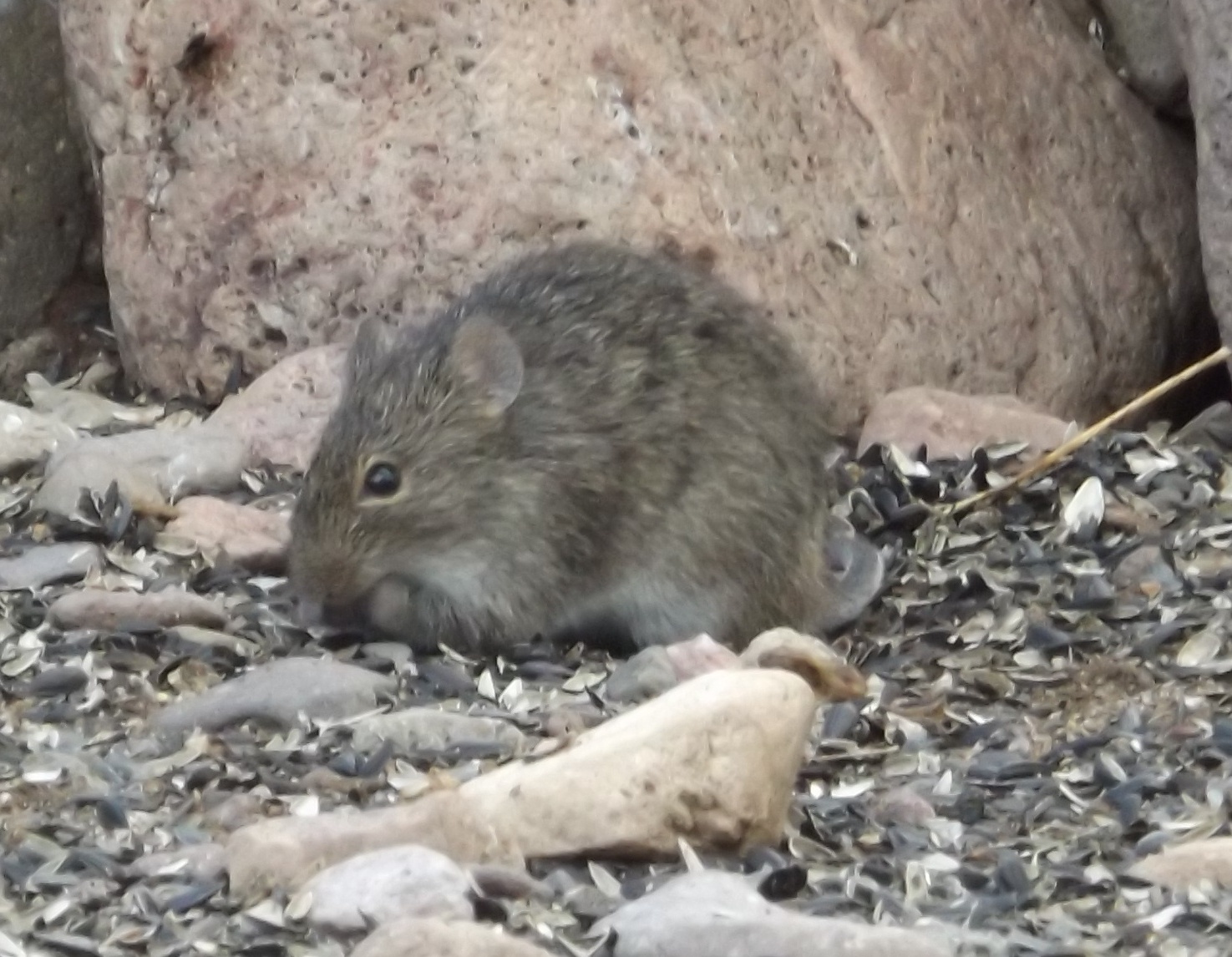
The Yellow-nosed Cotton Rat- a rodent with a very limited range within Arizona.

A male Hooded Oriole

A Curve-billed Thrasher of the celsum subspecies - a potential split.

A female Blue Grosbeak

A cottontail - Desert or Eastern?  I don't know.

Guess what else came in?!

A pair of Pyrrhuloxia!  My first photos of the species.

After spending 15 minutes at the feeders, our group decided to move on.  On our way back to the car, I pointed out the calls of a Greater Roadrunner and also noticed a Lesser Nighthawk flying around in the daylight.  Jennie MacFarland (trip leader and biologist) mentioned that it was still out foraging due to 'nest stress' from its young which compels the bird to continue providing food.  We hopped into the cars and made our way back to the station for breakfast.


On our way back, we rolled down the windows to simply look and listen.  I noticed a Loggerhead Shrike. Nice.  Caleb outdid me with a head-only Rufous-winged Sparrow - my lifer!  Very nice.  Then, Caleb outdid himself with a distant Botteri's Sparrow which we saw and heard!  (Another lifer!)


We were back at camp at 7 am.  Meals at the station are served cafeteria style and I was familiar with this setup not because I went to school (I was home-schooled all the way through high school in case you didn't know) but because I attended a lot of Boy Scout camps.  After a solid breakfast, the group made its way back down the mountain again to visit another feeder.  But before we left, I was walking to our room to grab a few things when I noticed something beside me on a tree trunk...


My lifer Arizona Woodpecker - definitely one of my top birds of the trip

This time, we were headed to Cave Creek Ranch, a very neat spot with an excellent feeder area zoned off with fences and well-stocked with food.  I didn't expect one non-bird species to be so prevalent here:


Javelinas!!!  They were just rooting around for whatever they wanted to eat and we just kept our distance.  These things were like pets here and so was another animal:


The delicate White-tailed Deer

Mammals aside, let's get to the main event....the birds!  


An Acorn Woodpecker; our views were fantastic!


This female Ladder-backed Woodpecker was also nice to see.

Black-backed Lesser Goldfinches

A male Black-headed Grosbeak at the suet feeder

Another Arizona Woodpecker!


My first good photo of a Mexican Jay!

Several White-breasted Nuthatches were at the feeders also


Other birds of interest that I did not photograph were Band-tailed Pigeons, Magnificent, Blue-throated, Black-chinned, and Broad-billed Hummingbirds, Western Wood Pewees, a Black Phoebe, Dusky-capped and Brown-crested Flycatchers, Cassin's and a Western Kingbird, and a Summer Tanager.  In an hour of birding there, Caleb, Dorian, and I had 35 species.

Moving on from the pleasant Cave Creek Ranch, we group made a quick stop at the South Fork of Cave Creek Canyon.  It was here that I saw my first Sulphur-bellied Flycatcher although I technically had my heard only 'lifer' while we were driving.  This strange flycatcher was one of my top lifers of the camp!  If you haven't heard their "rubber ducky" calls, then check them out here!


This flycatcher's reddish tail is one of its best field marks!

While we were walking around, we found a Cooper's Hawk, some Bewick's and Canyon Wrens, and a Painted Redstart among other species.  I also heard an Elegant Trogon calling and most of the people in our group got to hear it!  Around that time, the weather took a turn for the worse and heavy thunder came rumbling through the canyon like I've never heard before.  We decided to leave early.


On the road back to camp, I watched as one of our cars made a quick detour off the road and then stop.  We also stopped and asked what happened.  Well, apparently, someone saw a pair of Montezuma (Mearn's) Quail run into the nearby grass.  We set up a little perimeter and walked slowly hoping to flush this secretive gamebird into sight.  We all noticed the birds at the same time!  A male and female.  They ran quickly through the grass and then disappeared beyond our scope of view.


If you can find one in this photo, I'll be surprised!

The female Montezuma Quail

Now that I had seen my first Montezuma Quail, all three of Arizona's native quail species were under my belt.  I had also seen California and Mountain Quail in California.  Now, the only ABA quail I need is the Northern Bobwhite which I could get in Texas.  Back at camp, we had nothing to do for a few hours, so Caleb, Dorian, and I decided to walk around camp for even more birding.  The only new bird for the trip we found was a Zone-tailed Hawk.  However, we did find a lot of Striped Plateau Lizards!  They were stocky fence-lizard types that could be easily found running into the grasses when disturbed.  They weren't particularly fast, so we managed to catch a few.   


My lifer Plateau Striped Lizard

The orange blotch on its throat is quite unique

Here's a younger individual

Once it started getting dark, we headed back to our room so Caleb and I could gather our speaking materials as we were both giving presentations tonight.  I also had a chance to photograph more bugs around the rooms...


An unidentified longhorn beetle

A very large root borer

A massive fishfly

A Carolina Wolf Spider

These False Bombardier Beetles were fairly common

A possible Lophocampa moth

A Noctuid moth

A cockroach of the genus Arenivaga 

While waiting in line at dinner, we noticed a bit of commotion.  Turns out that a fledgling Northern Pygmy Owl was in the process of branching and was attempting to climb a tree.  It was just dark enough that my camera didn't operate well, so no good photos were taken.  I found it absolutely fascinating to watch this sort of behavior for the first time.  After maybe 10 minutes, one of the owl's parents flew in with a snack for the weary chick.  After we finished dinner, we headed off to the meeting room for the presentations.  Several knowledgeable young birders spoke before us and Caleb was second to last.  He spoke on the state of Cactus Ferruginous Pygmy Owls in Arizona.  He shared his photos and experiences with the species at an undisclosed location in the state.  After Caleb finished his speech, I began mine.  I spoke for 10 minutes concerning websites for birding and citizen science -  a topic that I am eager to share with others.  In my speech I presented 4 different online resources to the audience, briefly described the function of each, demonstrated how to use each sit, and then closed by handing out the information that I had just presented all summarized on a sheet of paper.  I hope at least someone joins eBird because of me!  For those of you who are interested in the websites I spoke of, here they are:


eBird                       WhatBird                      Project Noah                      xeno-canto


  After the night's speakers concluded their presentations, we geared up for another short owling venture.  Before we left, the leaders had set up a surprise for us!  One of the biologists who was working at the research station decided to give us a little show-and-tell with the companionship of a little Whiskered Screech Owl that he and his colleagues had recently netted!!!


The owl was surprisingly unafraid of us
             
While owling that night, we heard two Whiskered Screech Owls and heward four Elf Owls.  We were even able to call one of the Elvies in for a look...


Probably my best shot of an Elf Owl to date.

Staying up later to talk with Caleb and Dorian, I went to sleep somewhere around 11 pm.  What a day!  I never expected birding in the Chiricahuas to be this easy...or so good!  We still had a half-day of birding left the next day.  So keep an eye out for my next post!

Today's Accomplishments:  6 Lifers!

1.  Elegant Trogon  2.  Rufous-winged Sparrow  3.  Botteri's Sparrow  4.  Arizona Woodpecker  5.  Sulphur-bellied Flycatcher  6.  Montezuma Quail.

Bringing my life list to...343


Godspeed and good birding,

- Joshua