Thursday, May 12, 2016

California Coastal Tour Part 2: High Winds and High Hopes

Hey Readers!


Last time on Adam's Command...

Joshua Smith reacquaints himself with some of California's typical bird species!  He and Desmond Owers bird Webb Canyon Road and find a bunch of special species like California Thrasher, Wrentit, Oak Titmouse, and Olive-sided Flycatcher.  Desmond gets his 200th lifer (the OSFL) and Josh's head  hits the pillow hard back at Granny's house...


A sneak peek of what's to come...


Light comes through the shutters.  I stretch, get dressed, and lace on the hiking boots for an intense day of coastal birding.  First stop: breakfast at our family's favorite Mexican restaurant, El Merendero of La Verne, CA.  Second stop: a quick bathroom break in Huntington Beach, CA where I found this beauty singing his head off in a eucalyptus!


My first photos of a male American Goldfinch in his breeding colors.


Third stop:  Bolsa Chica Ecological Reserve aka "Tern Central". True to its nickname, someone had reported a rare Gull-billed Tern at the reserve the day before I went!  Typically, Gull-billed Terns stick around the San Diego area, but I guess this guy decided that the hunting would be better further north.  Gull-billed Tern aside, my top birds to see were Ridgway's Rail, Snowy Plover, Surf Scoter, Red Knot, and Whimbrel.  This trip would be my 3rd time birding Bolsa Chica.  Never had I experienced a dull moment here before!


The photo above is interesting in that it shows three species of tern in one frame.  Two Caspians (top left), two Royals (medium birds at right in mid-field), and one Elegant Tern (smallest bird at right).


Horned Grebe in breeding plumage


Common Side-blotched Lizard


Semipalmated Plover - these were fairly common


Ruddy Turnstone in breeding plumage - too far for good shots


Shortly after arriving, I met up with a group of several birders who were searching for the previously reported Gull-billed Tern   Becky Turley was among those birders.  Apparently, she is the top eBirder in California for 2016!  I did not know this until I perused California's eBird stats at home after the trip.  After hearing that the group had spotted the tern, Becky and I joined forces to intercept the bird from the opposite side of the channel over which it was hunting.  Because it is difficult to discern bill color from afar, we relied on habits to ID the bird.  The Gull-billed Tern is not a fisher like other terns, it tends to be more of a kleptoparasite or scavenger.  So, it makes sense that a tern hovering over land would probably be the one.  Within minutes, Becky had the tern in her scope!  The bird was hovering headfirst into the wind.  Becky was very generous in allowing me to peer through for a closer view.  A Gull-billed Tern indeed!  After the tern flew off, a couple other birders joined us to try and relocate the tern.  As we were walking, a man in the group pointed out an area where he has seen Whimbrels before and, sure enough, there were two!                    


My overdue lifer Whimbrel, a species of curlew. 

Further down the path, I noticed a small Larid flying towards me.  A birder yelled: "Bonaparte's Gull straight ahead!"  I managed this next shot as it passed me.  This gull was one of my favorite birds of the trip; a fantastic and quite unexpected lifer.     


This individual was still molting into breeding plumage as can be discerned by its patchy hood.

I spent close to 20 minutes with the group of birders in one area scanning for the Gull-billed Tern.  The tern was a no-show for the remainder of my time at Bolsa Chica, but I did manage to see some new shorebird species!  Becky Turley pointed out both a Dunlin and a Red Knot far out on a sandbar and I was afforded the opportunity to see these birds through her scope.  Not long after I saw my two lifer shorebirds, we all decided to head back as the winds had grown increasingly intense.  One man, whose name escapes me, told me that if I wanted to see a Surf Scoter, that I should check this one area of the inlet.  I took his advice without question and, amazingly, my lifer Surf Scoter was there -  peacefully paddling around on the far side of the inlet!  It was a brilliant male, but the harsh winds and the bird's far distance hindered me from taking any good photos.  I soon met up with a birder couple who had their scopes fixed on a sandbar covered in terns and gulls.  In addition to the usual terns and gulls, there were also some American White Pelicans and Double-crested Cormorants present.                   


The sandbar 


Here are the Elegant Terns.  They have slender bills - more "elegant" you could say.

At the fenced-off nesting area, I noticed a Least Tern sitting on the ground far away.  I made a quick remark to a birder about it and she laughed and told me it was a decoy!  I looked at it again and sure enough, it was a decoy!  Apparently, these decoys are supposed to entice real Least Terns to the area to nest.  Good job to whoever painted these!!!   


The object of my confusion


I assumed that these were decoys too until they started flying!!!


By this point, the wind had gotten to the point where I could no longer view anything in my scope without it shaking.  I decided it would be best to head out for our next stop, but of course I had to stop and check various points along the walkbridge to try in vain for my coveted Ridgway's Rail.  I did not find a single rail.  Instead, another birder pointed one out to me!!!  I could barely believe it...I would have left the reserve never knowing I missed this great bird.  The Ridgway's Rail was maybe 100 yards away from us at the edge of some thick vegetation.  It was actively preening and I got some good looks of its flashy orange bill.  My photos, however, didn't turn out so well...


Check out this Snowy Egret's fancy plumes and gold slippers!


Also, here is a Belding's Savannah Sparrow - an endangered subspecies.


Ah, I couldn't have asked for anything more.  I truly enjoyed my time here at the Bolsa Chica Ecological Reserve.  My seven life birds at this location were:  Gull-billed Tern, Whimbrel, Bonaparte's Gull, Red Knot, Dunlin, Surf Scoter, and Ridgway's Rail!  But my day was far from over, we still had two more stops to make!

4th stop of the day: Huntington Central Park.  This location is less than 10 minutes away from Bolsa Chica and, interestingly, has roughly 30 more species than its neighbor according to eBird.  HCP is a 350 acre park with varying habitat types.  Primarily, these are marshy/brushy areas, open woodland, and grassy areas.  There is also a pond and a hummingbird garden.  First, we birded along a dense marshy area.    


The marshy/brushy habitat type.  Great for warblers and sparrows!


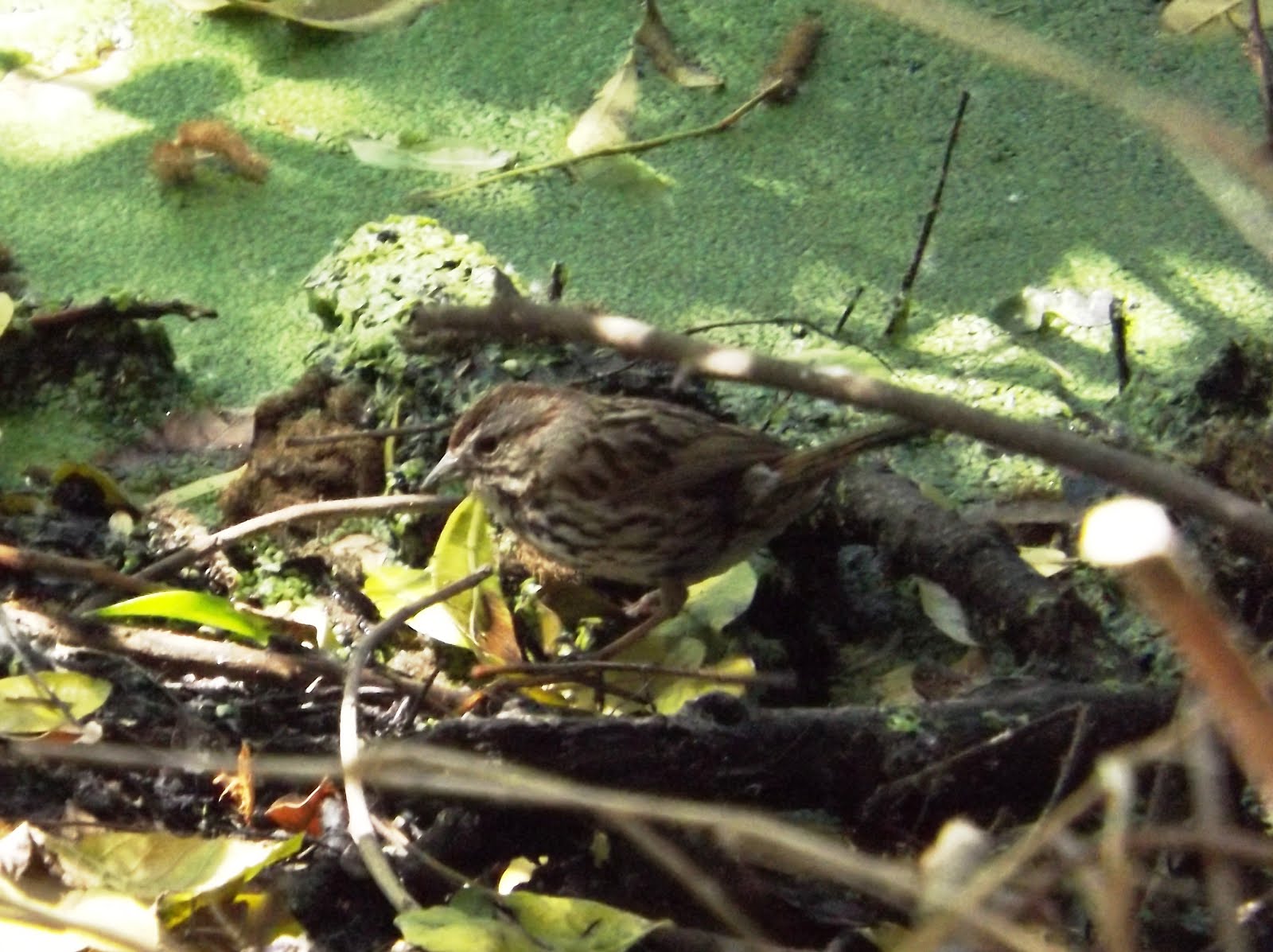
A skulking Song Sparrow


A Black-crowned Night Heron that I unintentionally flushed from a willow stand.


Other birds that I encountered in this area were Green Heron, House Wren, Bewick's Wren, Common Yellowthroat, Yellow Warbler, Yellow-rumped Warbler, and California Towhee.  Moving on, I focused on birding the grassy areas of the park with large trees...    


My first photo of a Downy Woodpecker!


A female Nuttall's Woodpecker.


A poorly focused shot of an American Robin.  


Other species here included Black Phoebe, Warbling Vireo, and Bushtit.  We passed by the pond on our way to the other side of the park hoping for an Egyptian Goose.  Unfortunately, there were no geese present apart from a few Canada Geese that were being fed by a visitor.  There was however a nice assortment of waterbirds including Northern Shoveler, Ruddy Duck, Double-crested Cormorant, Great Egret, Snowy Egret, and Black-necked Stilt.  There was also a lone male Red-winged Blackbird.


The Black-necked Stilt - one of my favorite waterbirds.


After departing from the pond, I encountered the Hummingbird Garden.  It is an exquisitely flowered area that is separtaed from the rest of the park by a chain link fence.  Immediately upon arriving, I found my "lifer" Red-cheeked Waxbill - an introduced species from Africa.  They were so incredibly small that at first I thought they were bugs!  


This pretty little waxbill was missing its tail.  Perhaps from molting?


A scene from the Hummingbird Garden.


Apart from the waxbills, there were no other birds present here - not even hummingbirds!  There was one Queen Butterfly - nothing else.  From here, my Mom, Brother, and I walked up a different trail that led to a dense area with eucalyptus trees that loomed above us.


I found this interesting woven nest in a eucalyptus.  
   

While scanning through the trees, I spotted this hunched over figure...


A roosting Great-horned Owl!


I walked around the tree for a better view...


After spending some time with my first GHOW in the OC, I heard another curious sound and decided to investigate. 


The strange high-pitched whistling call I was hearing was given by a young Allen's Hummingbird that was begging for food from its mother.  I didn't get to see the mother actually feed the fledgling, but I have heard that young hummers are primarily fed a diet of insects which is interesting if you consider the fact that hummers are primarily nectarivorous.  It is difficult to distinguish, but this young bird does have some green on its back which helps separate it from the similar Rufous Hummingbird.  Also, RUHU generally do not breed in California.

As we were leaving the park, I noticed a small swallow-like bird flying away from me.  After locking onto it with my binoculars, I determined it to be a Vaux's Swift - another lifer!  This has truly been the day of last-minute life birds.

5th stop: Newport Pier.  I didn't really expect to find much here, but from what I researched, scanning the ocean from the pier has turned up some nice seabirds before. 


Looking towards the Pacific


My brother and I braved the cold winds at the far end of the pier alongside some fishermen and Midwestern families.  I noticed a couple small rafts of Western Grebes not terribly far from the pier.  


The winds formed some fun waves to watch!


After about 20 minutes of scanning and nothing special, I decided to check out the waters near the pier.  I was pleasantly surprised to find my sole Eared Grebe of the trip.  


These two kids were having fun skateboarding with a homemade sail!


6th stop: Dinner at our favorite seafood restaurant, The Crab Cooker of Newport Beach.      
7th stop: Glendora, CA to visit with our friend and subsequently, retire for the night.

   
There will be a Part 3!  It gets a little colder, even windier, and much further north!!!  


Godspeed and good birding,

- Joshua

Tuesday, May 3, 2016

California Coastal Tour Part 1: A Student of Birds

Hey Readers!

I often miss my old patch at Webb Canyon Road.  Such great memories!  It was there that I practiced the basics of bird study - primarily their habits, sounds, and seasonal movements.  And I will never forget the moment I found my life bird Northern Flicker!  I was probably 14 or so.  Perhaps you could say it was my spark bird.  Seeing and hearing that woodpecker changed my perspective of birds from that point forward.  I didn't have a pair of binoculars at that time so I had to sneak up close to the bird in order to identify it!  I found it so very interesting to be able to observe the flicker's behavior at close range.  Following my avian paradigm shift, I graduated from...

"Bird Watcher" to "A Student of Birds".

My first shot of the Northern Flicker at Webb Canyon Road.

Enough of this nostalgic rambling, let's get on to the real show!

-----------------------------------------------------------------------------------------------------------------

Every year, my Aunt in California hosts a ladies' tea party that my Mom attends.  Last year, the photographer my Aunt hired didn't do such a hot job of photographing certain things... so she decided to hire me this year.  My Mom, Brother, and I decided to turn this trip into a family vacation with a strong emphasis on coastal birding!  I also had plans to bird Webb Canyon Road with my good friend Desmond Owers!  Sadly, my Dad couldn't make the trip; his work needed him to stay in Arizona.  Full of excitement, my Mom, Brother, and I left for California the morning of April 22nd...


My best attempt at photographing the great Colorado River which separates CA from AZ.

Some of the wind turbines that dot the landscape of SE California's hills.

San Jacinto Peak is the whitecap in the background.  I saw Bighorn Sheep there once!

-----------------------------------------------------------------------------------------------------------------

After completing the 5 hour drive to California, we slept at a friend's house in Glendora.  In the morning, I decided to conduct a little stationary count in her front yard to reacquaint myself with some of California's regular bird species.  Some highlights were a Nuttall's Woodpecker, a Barn Swallow, and a distant male Hooded Oriole.
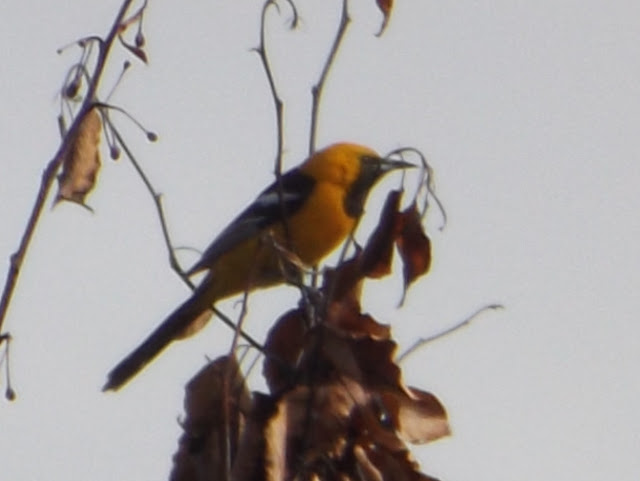

The Hooded Oriole in Glendora.
-----------------------------------------------------------------------------------------------------------------


So this is where all the birder girls go for their pedicures!  Haha!

We drove to my Aunt's house for the tea party after picking up some Native American art supplies at Matoska (I plan to create and sell replica war shields).  After the event, I decided to take a walk around her community.  It was very well landscaped and there were many tall sycamores, palms, and liquidambars.  Some notable species from this walk included a cooperative Song Sparrow, a pair of Cassin's Kingbird, and my second male Hooded Oriole of the trip.

One leg or two?!  


-----------------------------------------------------------------------------------------------------------------

We stayed at my Grandma's house in my hometown of La Verne that night.  In the morning, I enjoyed some of the birds on her porch.  She is quite dedicated to keeping her hummingbird feeder filled at all times, so there are always hummers at her house!  Species of interest included an Allen's Hummingbird, 2 Red-crowned Parrots (common and well-established here), and a Black-throated Gray Warbler.


Granny knows not to dye the nectar red!  This would be my ideal feeder setup.


Check out how decurved this female ALHU's bill is!


One of my favorite warblers, the Black-throated Gray.


Would have been a killer shot if only my camera focused correctly! :(

-----------------------------------------------------------------------------------------------------------------

We met up with our good friends, the Owers, to attend their Church (Claremont Bible Chapel).  After an excellent service, we drove back to their house which is only 5 minutes walking distance from my old patch!  My friend Desmond Owers and I decided to do some serious patch birding that afternoon.  We first noted a female Western Bluebird and - yet another - male Hooded Oriole visiting a neighbor's hummingbird feeder.  The oak woodland habitat at Webb Canyon Road was our first real stop...

My favorite tree


My patch has a lot of poison oak, you must take care not to brush up against any!


A couple interesting species that we encountered in the oak woodland section of my patch were Oak Titmouse and Black-throated Gray Warbler.

After a brief walk-through of the woodland, we entered a new habitat which is a mix of chaparral, seepwillow stands, oak woodland, sycamores, and eucalyptus forest.  This is by far the most productive area of my patch due to its rich plant diversity and accessibility.  Desmond and I spent most of our time here, walking up and down Webb Canyon Road.


Webb Canyon Road


Desmond Owers - ready to take on the birds!
          
One of several mountain bike trails that branch off from Webb Canyon Rd.


Last November, while birding with Caleb Strand, I learned the technique of pishing.  His blog is  http://birdingwithcaleb.blogspot.com/  by the way!  I have since then practiced it upon many an unsuspecting bird and have figured out which species respond to it and which ones could care less.  I was pishing towards a bunch of laurel sumac shrubs and a California Thrasher flew onto an exposed branch right in front of us!  Desmond and I both took stellar shots of this very nice bird.


We also found Wrentits, a Red-shouldered Hawk, a female Phainopepla, and dozens of other species along that section of road.  Later, I pointed out a bird on a very distant treetop and Desmond took some photos.  Desmond likes to go through his photos right after taking them and while doing so, he discovered that that bird was an Olive-sided Flycatcher!  For me, it was a state bird, and for Desmond, his 200th lifer!  I was honored to be a part of Desmond's milestone bird.

Up the road maybe a hundred yards, a non-native eucalyptus forest dominates the hillside.  It is eerily similar to an Australian forest and it is quite likely that my keen interest in this area when I was a kid led to my current aspiration to bird in Australia.  I almost bet that a family of kookaburra could live there happily!  No kookaburras were seen, but I did find some sleepy Band-tailed Pigeons high in a eucalyptus's branches.


In the eucalyptus stand, there were also Acorn Woodpeckers, Nuttall's Woodpeckers, Cassin's Kingbirds, and California Towhees.  In the skies above, several White-throated Swifts harnessed the power of the thermals as they searched diligently for insect prey.    


As our final stop, Desmond and I decided to check out a very birdy trail that is surrounded by thick vegetation and covered by the branches of tall oaks.  I was disgusted to find trash and beer cans littering the area.


I have far too much respect for my God who created this earth to do something like this to it.  It's like a slap in His face.  All nature is beautiful and I hate to see it degraded.  Desmond and I saw no birds here.  Perhaps they felt something was wrong after those people came?


Our route back to Desmond's house
   

A very handsome Band-tailed Pigeon


Desmond's bird feeder, an old Christmas gift from our family to his.


I strongly suggest that you visit Webb Canyon Road the next time you are near Claremont, CA if you want to see an Oak Titmouse, California Thrasher, or Wrentit!  This is the first of three posts that I will be making for my California Coastal Tour.  Many exciting birds, places, and stories await!

Godspeed and good birding,

- Joshua