Showing posts with label Olive-sided Flycatcher. Show all posts

Thursday, June 30, 2016

Birding's Biggest Day: Replacing Sleep With Soda

Hey Readers!

For two years now, eBird has been organizing the colossal Global Big Day count.  It is held on the 14 of May as an effort to census the avian spring migration.  In Arizona, the Global Big Day count is sponsored by the AZFO and the Cornell Lab of Ornithology.  My good friend Caleb Strand and I were invited by respected birder and AZFO board member Doug Jenness to take on the challenging task of birding the Boyce Thompson Arboretum in Pinal County for 2016's Global Big Day!  I visited the Boyce Thompson Arboretum (BTA) this last January and had a great afternoon of birding on a walk with my family.  I picked up 34 species such as a rare Yellow-bellied Sapsucker, an out-of-season Bell's Vireo, and a Canyon Towhee that day.  I was quite impressed by the size of the arboretum!  It was literally an oasis in the desert.  The Queen Creek flows past the park and supports a large cottonwood-dominated riparian area.  There is also a multitude of themed "microhabitats" such as an Australian eucalyptus forest, a Chihuahuan desert, a South American desert, and a Boojum forest!


Did I mention that the BTA is an IBA?

Before the count, I communicated extensively with BTA's volunteer coordinator Paul Wolterbeek to solidify certain details and to get a layout of the park.  He shared with me the locations of certain owl species that he had observed beforehand to help us along in our night birding.  I talked with Caleb quite a bit in preparation for the trip.  We decided on strategies and also came up with realistic numbers of species we could encounter.  Rarities and hard-to-find birds were also discussed at length.  BTA is further south of where I live and in a different county (Pinal).  There were also some species at the park that I hadn't seen, so I studied potentials extensively...


My desk in full bird-study mode!

Caleb and I arrived on the grounds of the arboretum around 3 pm on May 13th.  We decided to scout the area from 4pm - 12 am.  Our search was off to a rocking start with a pair of Inca Doves that flushed excitedly from the ground.  A little further up towards the gift shop, Caleb pointed out my lifer Broad-billed Hummingbird!  A brilliant male and subtly-colored female were present.  In a high snag near the gift shop, an Olive-sided Flycatcher sallied for insects and returned to its perch with a steady rhythm.  Other highlights of the scouting trip included Broad-billed Hummingbirds, Harris's Hawks, a Zone-tailed Hawk, MacGillivray's Warblers, Lark Sparrows, and some Canyon Towhees.  The Broad-billed Hummingbirds were a life bird for me!  Here are some shots of the birds we found while scouting and some photos from around the park... 


One of many Hooded Orioles we encountered


A young White-winged Dove


An Olive-sided Flycatcher


The OSFL's vest is clearly evident here


A brilliant Yellow-breasted Chat

A Zone-tailed Hawk


The Turkey Vultures gather in a big flock before roosting for the night


Caleb surveying the Queen Creek riparian area before sundown

The small, but important, Ayer Lake

The lower parking lot - seemingly mundane, but excellent for Vermilion Flycatchers


The TUVU spot

There they are...


...watching your every move!

Once it started getting dark, we grabbed water and our flashlights and headed over to the riparian area to begin our long night of owling.  We were pleasantly surprised to find a pair of Great-horned Owls in some cottonwoods.  Later that night, we encountered a family of Western Screech Owls - a parent and three fledglings.  The parent had a cricket in its mouth for a lucky chick.  We discovered that one of the youngsters already had a mouse in its talons which it pecked at leisurely.  (Great job, parents!)  


Here, an adult carries a cricket in its bill.


One of the fledglings with the unidentified slain mouse.


Here is another fledgling which remained mostly still on its exposed perch.

After spending a fantastic half hour with the owls, Caleb and I decided it would be best to move on to try for another high-profile target of the night, the Elf Owl.  Elvies are super tiny, in fact, they are the smallest owl species on earth!   Caleb and I used playback judiciously throughout the trip because we needed to locate certain species for the count.  We stopped at several spots, played recordings, and listened until we heard a faint bark...  We played the recording again and then, maybe a 100 feet away, the Elf owl started chuckling its head off!  I will never forget that sound.  We coaxed the bird to come in closer, and sure enough, it landed in a shrub nearby.  


My lifer Elf owl

The Elf flew from the shrub elsewhere after a 30 second photo shoot.  We were unable to locate the bird again after that, so we moved on through the night.  Apart from a calling Common Poorwill and some night-singing Yellow-breasted Chats, the night was dead.  When 12 am rolled in and the count had officially begun, so we turned back to try for the owls from "last night".  


We succeeded in locating the Western Screech Owls, Great-horned Owls, and Common Poorwill to kickstart our big day.  While we were trying to relocate the Elf, we heard a massive crash in the eucalyptuses above us!  In a moment of terror, Caleb and I shined our lights up to witness a large flock of Turkey Vultures flying away from their night roosts.  When you are straining to hear the world's smallest owl in the dead of night, loud sounds can be quite unnerving!  Maybe a hour after that, we heard a Barn Owl's distinctive shriek - a sound that used to frighten me as a kid!  Some non-owl species also made their way on our list during the dark morning hours.  These included Mourning Doves, Yellow-breasted Chats, and Northern Cardinals.


Just before the dawn chorus began, Caleb and I headed over to Ayer Lake and picked up White-throated Swifts, Black Phoebes, Northern Rough-winged Swallows, Violet-green Swallows, Common Yellowthroats, and Song Sparrows.  Soon, the sun was beginning to rise, so we decided to watch and listen along Queen Creek.  Upon arrival, we picked up Brown-crested Flycatchers, Western Wood Pewees, Blue-gray Gnatcatchers, Phainopeplas, Summer Tanagers, Western Tanagers, and a rare flyover Pine Siskin!  After hiking to a secluded spot in the shade of the cottonwoods, we settled down and listened to the surrounding birds...  A Rufous-crowned Sparrow sang out from a scrubby hillside.  Ladder-backed Woodpeckers could be heard giving their sharp "peek" calls from the cottonwoods to the south.  Excitement arose as a Cooper's Hawk cruised along the riparian corridor hoping to nab any unwary songbirds.  A couple Pacific-slope Flycatchers also called periodically from different locales.  The Canyon Wrens drenched our ears with their sweet cascading songs.  Although Queen Creek was a little stretch of paradise, we knew we had to move on throughout the park to accurately record its diversity.  


A male Summer Tanager

Trekking along Queen Creek and then off towards the main entrance, we encountered typical desert species such as Gambel's Quail, White-winged Dove, Costa's Hummingbirds, Gila Woodpeckers, Verdins, Cactus Wrens, Curve-billed Thrashers, Lucy's Warblers, Black-throated Sparrows, Canyon Towhees, and Abert's Towhees.  We also came across our first Broad-billed Hummingbirds of the day.  By now, our Big Day list had surpassed 50 species and it wasn't even 7 am yet!  


A female Broad-billed Hummingbird - a lifer only yesterday!


We met up with BTA's business manager, Patti Baynham at the gift shop at 7 am and proceeded to work our way back through the heart of the arboretum.  Patti, Caleb, and I enjoyed finding a rare Purple Martin that flew over Ayer Lake briefly before taking off into the surrounding desert.  We also added some other interesting birds to the day's list including a flock of Cedar Waxwings, MacGillivray's Warblers, a Bronzed Cowbird, and an Indigo Bunting (a lifer for me)!  Around noon, Patti parted ways with us after a fantastic morning of birding.  
           

A Brown-crested Flycatcher

My lifer Indigo Bunting

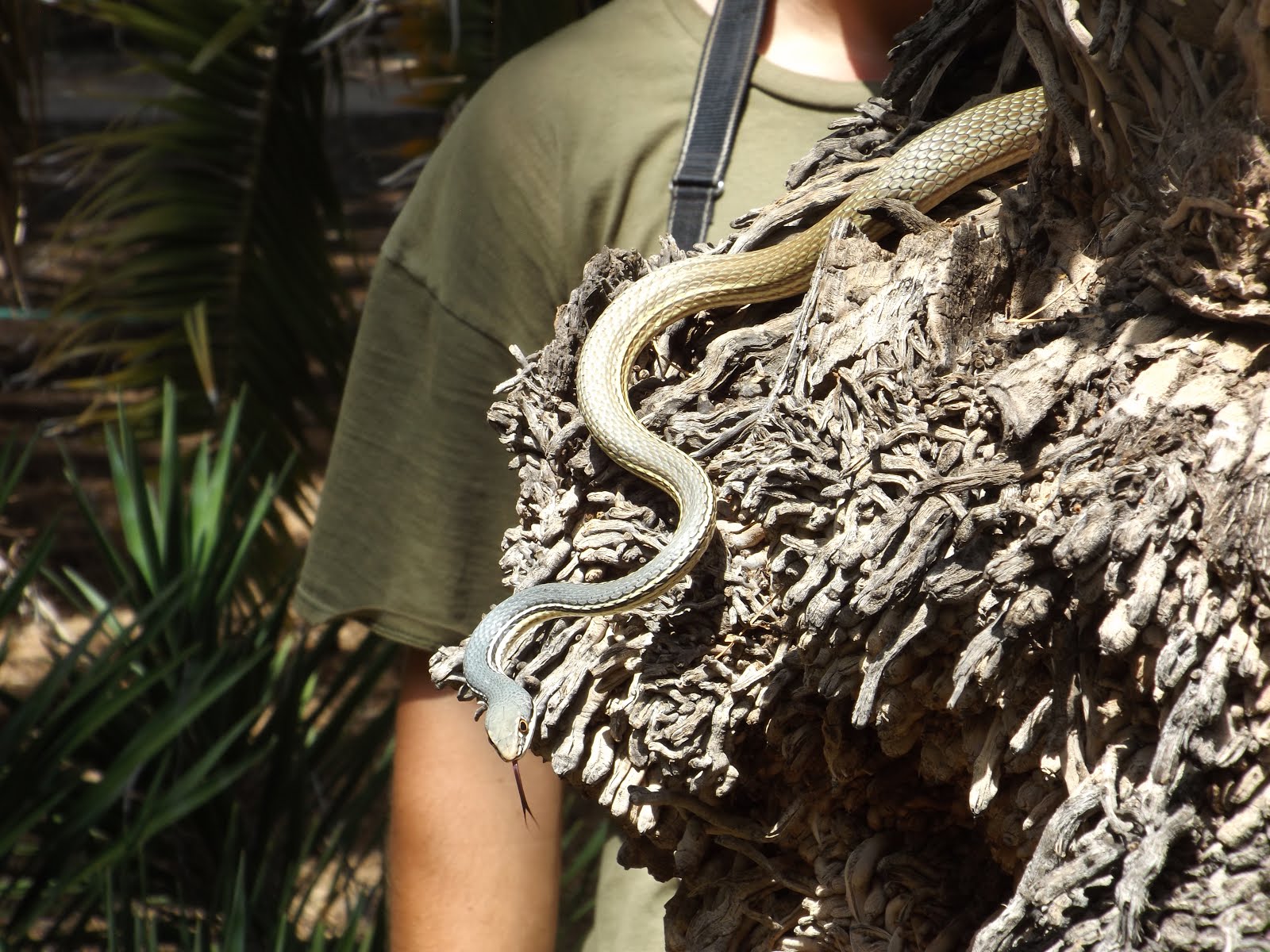
Naturally, after 28 hours without sleep, we were exhausted but determined to provide an accurate census of the arboretum's birdlife.  Caleb's catchphrase is "Bird Hard" and we did exactly that!  We pushed onward through the heat of the day to add more species to our Big Day list.  Because it is cooler in the shade, Caleb and I decided to bird along the Gum Bark Trail.  Its tall pines and eucalyptuses offered a nice respite from the mid-day sun.  Caleb and I quickly picked out a Dusky Flycatcher, Hammond's Flycatcher, Townsend's Warbler, and Hermit Warbler.  Soon after a nice rest rest on a nearby bench, I spied something moving across a palm trunk.  It was a Sonoran Whipsnake; a new reptile for both of us and certainly our favorite of the trip!  After narrowly missing a few lunges from the angry snake, Caleb managed to grab its head and we thoroughly photographed the fine creature.   


After studying this new snake, Caleb let it go into the brush at the base of the palm.  The snake took off like a rocket!


This Striped Whipsnake had enough of us!

After the herp excitement ceased, we continued birding.  In many areas of the park, we heard Black-headed Grosbeaks giving their "spik" calls which are reminiscent of your shoe squeaking on a polished floor.  Think basketball...   After a slow couple of hours, a great surprise came in the form of a Prairie Falcon which was riding the thermals out in the distance.  Throughout this whole event, we had been spending maybe 10 minutes every couple of hours in a room onsite to rest and refuel.  We headed over to the hummingbird feeder area around 3 or 4 pm.  Some good birds there included a Green-tailed Towhee and a Lincoln's Sparrow (the feeders were all dry).  We noticed a birder walking around nearby and decided to talk to him a little.  He was visiting the arboretum all the way from Louisiana!  We told the man about that Lincoln's Sparrow we had only minutes before and we were all able to relocate it - a lifer for him!        


Hopefully, this work of art from our room won't haunt your dreams tonight...


It was rapidly becoming dark, so Caleb and I ate a quick dinner and geared up for another night of owling!  We focused our efforts on areas that Elf Owls would prefer and eventually heard a few Elvies in the nearby wash.  After nearly an hour of hiking to try and locate the owls, we scored on a pair that had nested in a saguaro!  


In honor of the movie "Elf", we named the couple Buddy and Jovi.  Buddy soon left the area to find his mate some food so she could incubate her eggs uninterrupted.  We sat still at the base of the saguaro that the owls had nested in to wait for Jovi to pop her head out.  When she did, it was often so brief that we couldn't get any photos.  Eventually, she held the pose long enough for us both to get decent shots!  Jovi began calling with increased intensity over a period of 10 minutes.  She was calling to her mate as if to say "Honey, how long does it take to catch me a cricket?!"  Jovi was beyond hangry, so she exited the nest cavity in a silent flurry of motion to get her own meal.   


After having spent a considerable amount of time with the Elf Owls, we decided to bird other areas of the arboretum until midnight.  Since we didn't need any more owls, Caleb and I decided that it would be interesting to find birds on their night roosts.  We started out the search strong with some Inca Doves, White-winged Doves, a Wilson's Warbler, and many Brown-crested Flycatchers.  After our initial findings, we did not find anything new apart from some Gambel's Quail and a cranky House Finch.  Thoroughly exhausted and sick of drinking soda, we watched the time on our phones change to 12:00 am and that was the end of our Global Big Day.


A sleepy male Wilson's Warbler


One of the many Brown-crested Flycatchers that we awoke


Yeah, we drank all those...and over 30 bottles of water!


After rejoicing in the completion of our first 24 hour count, Caleb and I trekked back to our room.  Immediately when my head hit the pillow, I was out!  I literally can't remember falling asleep faster in my entire life.  In summary, we tallied Boyce Thompson Arboretum's all-time high count of 81 species and birded nonstop for those 24 hours (apart from several short breaks for food, water, and caffeine).  eBird later announced that 2016's count was "Birding's Biggest Day" as nearly 16,000 of the world's birders reported 6,263 species in only 24 hours.  It is absolutely incredible to think that so many of the world's bird species were encountered in only one day!  When I read that report, I realized that our contribution was only a drop in the bucket amidst tens of thousands of others.  Caleb and I both agreed that this trip was one of the best of our lives.  I really can't wait for my next 24 hour birding expedition.  It's an incredible thing to be a part of a location's entire daily cycle...to hear Brown-crested Flycatchers sing in the riparian area at dawn...to see them disperse throughout the park to feed in the day...to watch them as they sleep in the trees at midnight.  24 hours in one place offers an observer perspective and a deeper understanding of an ecosystem's circadian rhythm.  


Godspeed and good birding to you all,

- Joshua        


P.S.  This post is not the end of our 24 hour expedition - there is another untold story yet to be told...


Tuesday, May 3, 2016

California Coastal Tour Part 1: A Student of Birds

Hey Readers!

I often miss my old patch at Webb Canyon Road.  Such great memories!  It was there that I practiced the basics of bird study - primarily their habits, sounds, and seasonal movements.  And I will never forget the moment I found my life bird Northern Flicker!  I was probably 14 or so.  Perhaps you could say it was my spark bird.  Seeing and hearing that woodpecker changed my perspective of birds from that point forward.  I didn't have a pair of binoculars at that time so I had to sneak up close to the bird in order to identify it!  I found it so very interesting to be able to observe the flicker's behavior at close range.  Following my avian paradigm shift, I graduated from...

"Bird Watcher" to "A Student of Birds".

My first shot of the Northern Flicker at Webb Canyon Road.

Enough of this nostalgic rambling, let's get on to the real show!

-----------------------------------------------------------------------------------------------------------------

Every year, my Aunt in California hosts a ladies' tea party that my Mom attends.  Last year, the photographer my Aunt hired didn't do such a hot job of photographing certain things... so she decided to hire me this year.  My Mom, Brother, and I decided to turn this trip into a family vacation with a strong emphasis on coastal birding!  I also had plans to bird Webb Canyon Road with my good friend Desmond Owers!  Sadly, my Dad couldn't make the trip; his work needed him to stay in Arizona.  Full of excitement, my Mom, Brother, and I left for California the morning of April 22nd...


My best attempt at photographing the great Colorado River which separates CA from AZ.

Some of the wind turbines that dot the landscape of SE California's hills.

San Jacinto Peak is the whitecap in the background.  I saw Bighorn Sheep there once!

-----------------------------------------------------------------------------------------------------------------

After completing the 5 hour drive to California, we slept at a friend's house in Glendora.  In the morning, I decided to conduct a little stationary count in her front yard to reacquaint myself with some of California's regular bird species.  Some highlights were a Nuttall's Woodpecker, a Barn Swallow, and a distant male Hooded Oriole.

The Hooded Oriole in Glendora.
-----------------------------------------------------------------------------------------------------------------


So this is where all the birder girls go for their pedicures!  Haha!

We drove to my Aunt's house for the tea party after picking up some Native American art supplies at Matoska (I plan to create and sell replica war shields).  After the event, I decided to take a walk around her community.  It was very well landscaped and there were many tall sycamores, palms, and liquidambars.  Some notable species from this walk included a cooperative Song Sparrow, a pair of Cassin's Kingbird, and my second male Hooded Oriole of the trip.

One leg or two?!  


-----------------------------------------------------------------------------------------------------------------

We stayed at my Grandma's house in my hometown of La Verne that night.  In the morning, I enjoyed some of the birds on her porch.  She is quite dedicated to keeping her hummingbird feeder filled at all times, so there are always hummers at her house!  Species of interest included an Allen's Hummingbird, 2 Red-crowned Parrots (common and well-established here), and a Black-throated Gray Warbler.


Granny knows not to dye the nectar red!  This would be my ideal feeder setup.


Check out how decurved this female ALHU's bill is!


One of my favorite warblers, the Black-throated Gray.


Would have been a killer shot if only my camera focused correctly! :(

-----------------------------------------------------------------------------------------------------------------

We met up with our good friends, the Owers, to attend their Church (Claremont Bible Chapel).  After an excellent service, we drove back to their house which is only 5 minutes walking distance from my old patch!  My friend Desmond Owers and I decided to do some serious patch birding that afternoon.  We first noted a female Western Bluebird and - yet another - male Hooded Oriole visiting a neighbor's hummingbird feeder.  The oak woodland habitat at Webb Canyon Road was our first real stop...

My favorite tree


My patch has a lot of poison oak, you must take care not to brush up against any!


A couple interesting species that we encountered in the oak woodland section of my patch were Oak Titmouse and Black-throated Gray Warbler.

After a brief walk-through of the woodland, we entered a new habitat which is a mix of chaparral, seepwillow stands, oak woodland, sycamores, and eucalyptus forest.  This is by far the most productive area of my patch due to its rich plant diversity and accessibility.  Desmond and I spent most of our time here, walking up and down Webb Canyon Road.


Webb Canyon Road


Desmond Owers - ready to take on the birds!
          
One of several mountain bike trails that branch off from Webb Canyon Rd.


Last November, while birding with Caleb Strand, I learned the technique of pishing.  His blog is  http://birdingwithcaleb.blogspot.com/  by the way!  I have since then practiced it upon many an unsuspecting bird and have figured out which species respond to it and which ones could care less.  I was pishing towards a bunch of laurel sumac shrubs and a California Thrasher flew onto an exposed branch right in front of us!  Desmond and I both took stellar shots of this very nice bird.


We also found Wrentits, a Red-shouldered Hawk, a female Phainopepla, and dozens of other species along that section of road.  Later, I pointed out a bird on a very distant treetop and Desmond took some photos.  Desmond likes to go through his photos right after taking them and while doing so, he discovered that that bird was an Olive-sided Flycatcher!  For me, it was a state bird, and for Desmond, his 200th lifer!  I was honored to be a part of Desmond's milestone bird.

Up the road maybe a hundred yards, a non-native eucalyptus forest dominates the hillside.  It is eerily similar to an Australian forest and it is quite likely that my keen interest in this area when I was a kid led to my current aspiration to bird in Australia.  I almost bet that a family of kookaburra could live there happily!  No kookaburras were seen, but I did find some sleepy Band-tailed Pigeons high in a eucalyptus's branches.


In the eucalyptus stand, there were also Acorn Woodpeckers, Nuttall's Woodpeckers, Cassin's Kingbirds, and California Towhees.  In the skies above, several White-throated Swifts harnessed the power of the thermals as they searched diligently for insect prey.    


As our final stop, Desmond and I decided to check out a very birdy trail that is surrounded by thick vegetation and covered by the branches of tall oaks.  I was disgusted to find trash and beer cans littering the area.


I have far too much respect for my God who created this earth to do something like this to it.  It's like a slap in His face.  All nature is beautiful and I hate to see it degraded.  Desmond and I saw no birds here.  Perhaps they felt something was wrong after those people came?


Our route back to Desmond's house
   

A very handsome Band-tailed Pigeon


Desmond's bird feeder, an old Christmas gift from our family to his.


I strongly suggest that you visit Webb Canyon Road the next time you are near Claremont, CA if you want to see an Oak Titmouse, California Thrasher, or Wrentit!  This is the first of three posts that I will be making for my California Coastal Tour.  Many exciting birds, places, and stories await!

Godspeed and good birding,

- Joshua