Hey Readers!
Still weary and weather-beaten from my California Coastal Tour, I geared up once again for a trip to Maricopa County's fabled high elevations! Tommy DeBardeleben, Gordon Karre, and I set the plan in concrete while I was still in California. We were originally hoping for early May, but the weather had been unpredictable lately and we decided to take advantage of a favorable forecast. So, barely an hour after arriving home from my six day trip to California with no shower and no dinner, Tommy and I departed for the Slate Creek Divide armed with binoculars, cameras, flashlights, camping gear, and our anticipation of what was to come!

Our first stop was at Little Caesar's Pizza of course. We bought 3 pizzas and threw them in the back of the truck to munch on throughout our trip. No hassle there! Tommy brought plenty of water knowing that it is by far the most important necessity of any outdoor outing. We talked mostly about birds, birding, and birders on the way up to Slate Creek. I needed over 30 species at Slate Creek in April for my Maricopa County life list (which I am particularly fond of). Many of those species have extremely limited ranges within the county or are just simply hard to find. Above all, I was looking forward to the possibility of various owl species; Spotted, Flammulated, Northern Saw-whet, and Northern Pygmy Owls.
Around 6 pm, we arrived the Mt. Peeley Trailhead after driving along a sketchy stretch of road that ascends the mountain. Gordon Karre was there already waving at us as we drove up. I had never met Gordon until then and was thrilled to meet another of Arizona's great birders! We quickly began pitching our tents at the trailhead so we could get out as soon as we could for our night of owling. We all agreed that our campsite looked pretty awesome when it was completed. Tommy heard a Northern Pygmy Owl calling on a trail close by and he took Gordon and I back to hear it. We picked it up quickly at the spot Tommy heard it. My lifer Northern Pygmy Owl! Soon, we were ready to head down the road, so we grabbed our flashlights and cameras and hopped in the truck. Not long after starting back down the trail, Tommy spied a Common Poorwill in the middle of the road! I had never seen one up close, so this was a real treat.
 |
| Here's Tommy and Gordon walking closer to the bird. |
 |
| The Common Poorwill, a member of the nightjar family. |
After spending 15 minutes or so with the poorwill, we decided to head further down the trail to a path that parallels a drainage on the Maricopa County side of Slate Creek. This spot turned out to be a total bust as the wind made it impossible to hear any distant night birds. We ditched this spot and instead, walked up the main trail a ways. Tommy paused a moment and said "listen!" Gordon and I strained our ears to hear a steady hooting from the forest below us. It was a Flammulated Owl! Unfortunately, it was on the Gila County side, but hey, who cares about that when you have such a special owl? Tommy tried calling the bird in, but it wouldn't really come in any closer. We decided to try to work our way down the slope to get closer to the bird. Gordon opted out. Tommy and I nearly tripped a few times, but remianed mostly intact. After a lot of trailblazing, we thought we located the tree it was in, but then the calls sounded like they were coming from a different direction. This is called ventriloquism, and the Flam is a master of it. We had spent nearly a half hour trying to get a visual of the bird when Tommy spied it finally! It was perched in the low branches of a Douglas Fir. I was really excited to see this little owl for the first time! Tommy was equally thrilled and we took tons of photos of this bird. We didn't use flash and we tried to avoid shining bright lights in its big black eyes. several times, but we remained mostly intact.

 |
| Here's Tommy's owl selfie! Can you see the Flam towards the top of the trunk? |
As we stood beneath this great owl, we remembered that Gordon was waiting for us up on the trail and we both really wanted him to see the Flam. This was a once in a lifetime experience for sure! Tommy persuaded Gordon to come down the slope and he was able to do so with ease. When Gordon first saw the owl I could tell that he was more than happy! Tommy has a golden ear and can distinguish sounds that I can barely discern even after being told of them (maybe I play guitar a little too loud?). A strange bu steady sound was coming from the forest to the east. A Northern Saw-whet Owl was nearby. I was really excited as the Saw-whet is an owl that I've wanted to see for a long time. Tommy used some playback and the owl fluttered around like a moth while it floated weightlessly in the air before us for 3-5 seconds! After this ghostly appearance, the Saw-whet perched in a dead tree nearby and we got some good looks and a couple photos before it took off.
 |
| Those eyes... |
Northern Saw-whet Owls are arguably the "cutest" owl in North America. Just look at that fluffy face! I do think that Burrowing and pygmy owls come in pretty close though. At one point in the night, we could heard the Flam, Saw-whet, and a Great-horned Owl all calling simultaneously! Pretty awesome. After spending a good few hours with those owls, we were getting a little antsy, so we decided to try some different areas. As we were driving, Tommy heard another (?) Northern Saw-whet Owl calling this time from the Maricopa side! I was really happy to get this bird for my Maricopa List! A fine addition I would say. When we got back to camp, Tommy and I decided to owl a little more in a nearby drainage. We set out and soon I flushed a bird from the ground. It was a Painted Redstart - my lifer to be exact! Tommy mentioned that the bird was likely on its nest in a clump of grass on the ground. What a way to get a life bird. That would be the last bird of the night. After a half hour search, it was around 1 am and we decided to get some sleep. I didn't sleep too well probably because I was too excited for the morning!
Soon, it was morning and we all ate our breakfasts and geared up for a fun morning of drainage hiking. Tommy thought it would be worthwhile to try for that Northern Pygmy Owl from last night before heading down the drainage, so I joined him. I picked up several Maricopa life birds in that area including Steller's Jay, Grace's Warbler, Virginia's Warbler, Scott's Oriole, and Cassin's Finches!
 |
| The Cassin's Finches |
Soon, we were at the pygmy owl spot and, after a while, the owl started calling! We carefully traversed the slope in order to get a visual on the bird. I was able to discern the owl's shape in the mid-level branches of a Ponderosa down the slope. Tommy and I photographed the owl well and then just stood still and listened to it.
 |
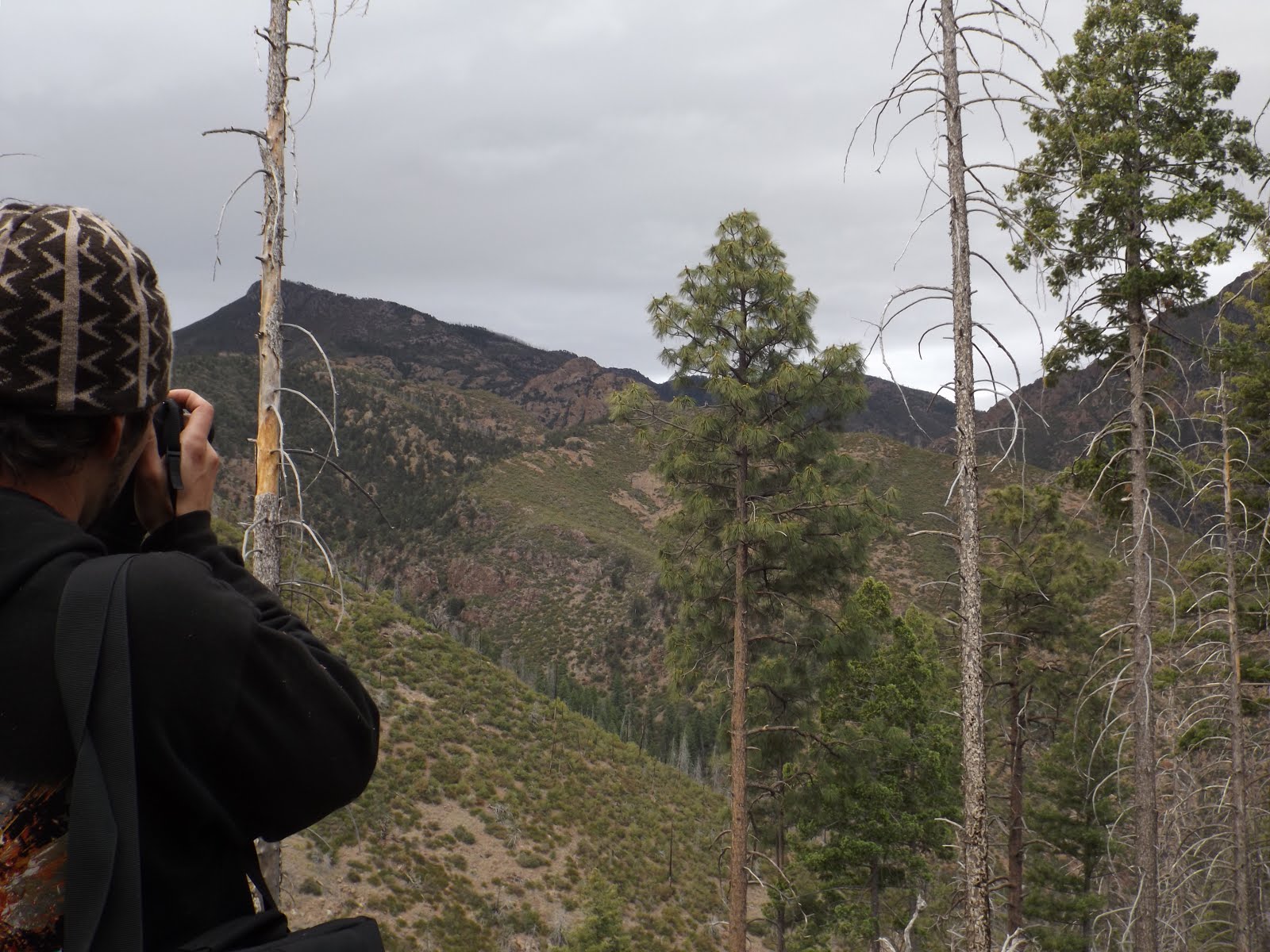
| Tommy taking photos of the NOPO which was in the pine at center. |
My favorite thing about pygmy owls are their false eyes which you can see above. These eyes protect the owl from predators that would otherwise attack the owl from behind. After posting this photo to Project Noah, I received a comment from a member who lives in India who said that fishermen in the Sunderbans wear masks on the back of their heads with "eyes" that apparently discourage tigers from attacking them! A similar ploy as the owl's indeed. We also witnessed several massive flocks of Violet-green Swallows that flew by from further north. We estimated 200 individuals. Perhaps there is a big colony hidden in the Mazatzals?
Tommy decided that that we should get going so we can bird a nearby drainage for the remainder of the trip. Gordon and I had never birded Slate Creek before, so we were hoping for Mexican Spotted Owls, Dusky-capped Flycatchers, and Mexican Jays. For me, all three would be lifers, but Gordon had seen them in other parts of Arizona before.
 |
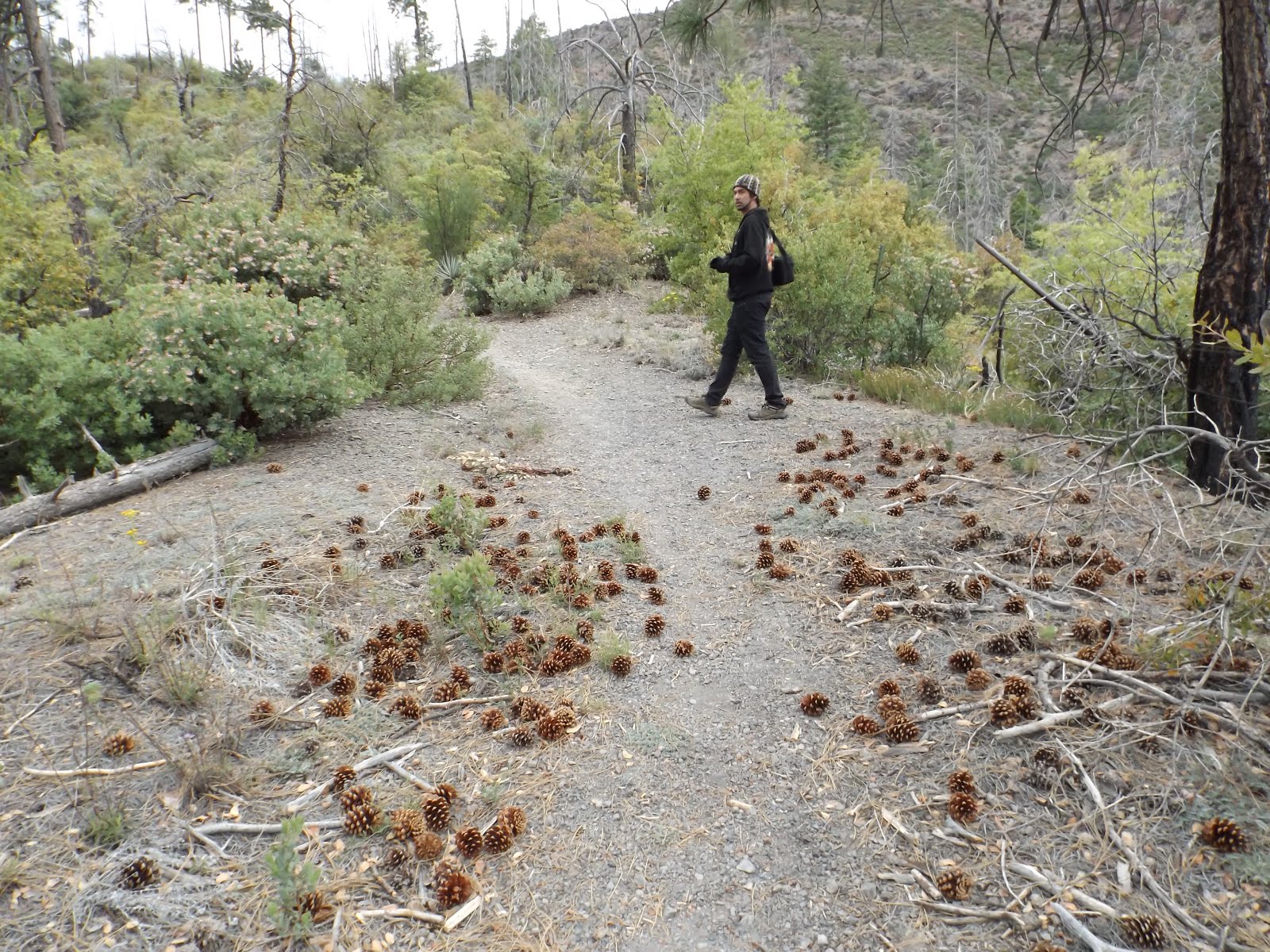
| Tommy kept in the lead most of the time to look and listen for any good birds. |
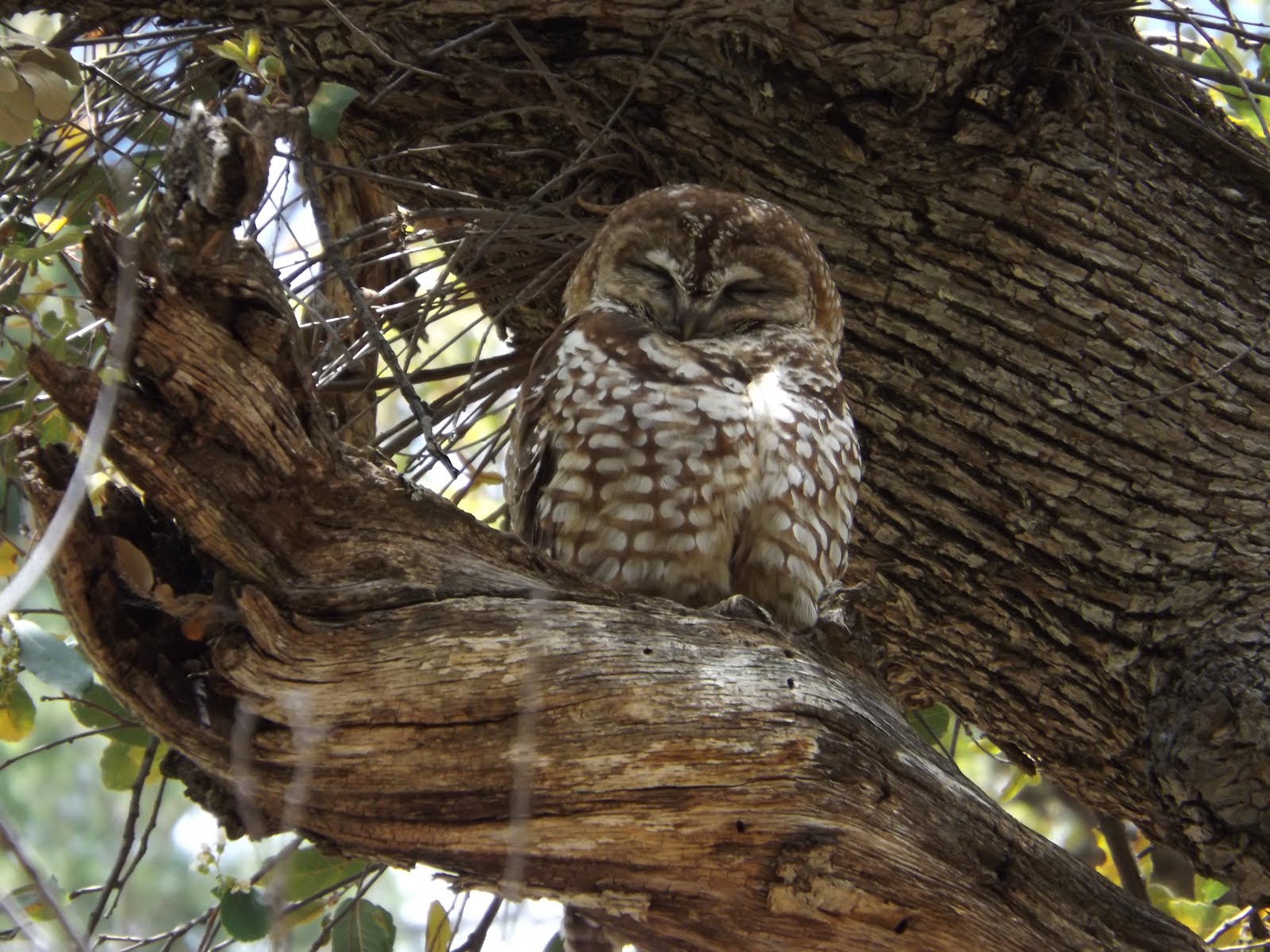
Not long after embarking on our hike, Tommy paused, looked intently into the forest, and loudly whispered "I've got the Spotted Owl." Swiftly and carefully walking over to him, Gordon and I laid eyes on our first ever Spotted Owl for Maricopa County. You know, the same county in which Phoenix is located?
Shortly after seeing the owl, a little sprinkle of rain started falling. It wasn't much, but we were a little concerned for our optics and cameras. The rain forced us to move onward in search of our next targets, Thankfully, after about 15 minutes of hiking, the rain faded so we could enjoy fair weather the rest of the morning.
 |
| The remains of a deer; perhaps a Mountain Lion's kill? |
There were good numbers of songbirds in the ravine. We encountered Dusky and Hammond's Flycatchers, Plumbeous and Hutton's Vireos, all three western nuthatches, Brown Creepers, Townsend's Warblers, and many others. I truly enjoyed getting my first ever Red-breasted Nuthatch in a mix of songbirds that were excited by our pishing.
Because I enjoy studying all living things, I couldn't help but notice that the plant life at Slate Creek was nearly as varied as the birds! There were ferns, oaks, pines, spruce, firs, maples, boxelders, a multitude of forbs, and a variety of large shrubs. In the ravine, we had to be careful of the abundant Stinging Nettle and Poison Ivy. I am familiar with Poison Oak from living in California, but I had never seen Poison Ivy before and I found the plant interesting.
 |
| Poison Ivy |
 |
| Stinging Nettle |
 |
| Some kind of fern |
 |
| Lupine |
 |
| A wildflower that I wish to identify |
After hiking pretty far down the drainage, we came upon the confluence of our wash and another. This area is apparently the most reliable spot for Dusky-capped Flycatchers at Slate Creek. We soon found out that it indeed was! We first detected them by their mournful whistles. Eventually, we could see a few in the trees nearby. They were not the most cooperative bird I've encountered, but I did manage some decent photos.
Because I love the family Tyrannidae, I was particularly excited to see these Dusky-capped Flycatchers for the first time. They are small Myiarchus flycatchers with particularly dark heads.
 |
| My best shot of the beautiful Painted Redstart. Very active! |
 |
| Slate Creek's namesake |
After spending some time with the flycatchers and searching a bit more for Red-faced Warblers, we decided to head back as it was approaching noon. On our way back, we searched again for the Spotted Owl from earlier this morning. It was still there!
 |
| Can you see the owl perched in this warped, old oak? |
 |
| So tired after a long night of mousing... |
After thoroughly enjoying our time with the SPOW, we hiked out of the drainage and back towards our campsite. I looked back at the drainage one last time as we were leaving. Such an amazing place.
 |
| Some of the signage at Mt. Peeley Trailhead |
After breaking down camp, Tommy and I bid farewell to Gordon. Then, we made our descent down the mountain...
 |
| Many of the drainages here are surrounded by this chaparral type habitat. |
 |
| Here is Slate Creek's lower elevations. Juniper and scrub oak dominates the landscape. |
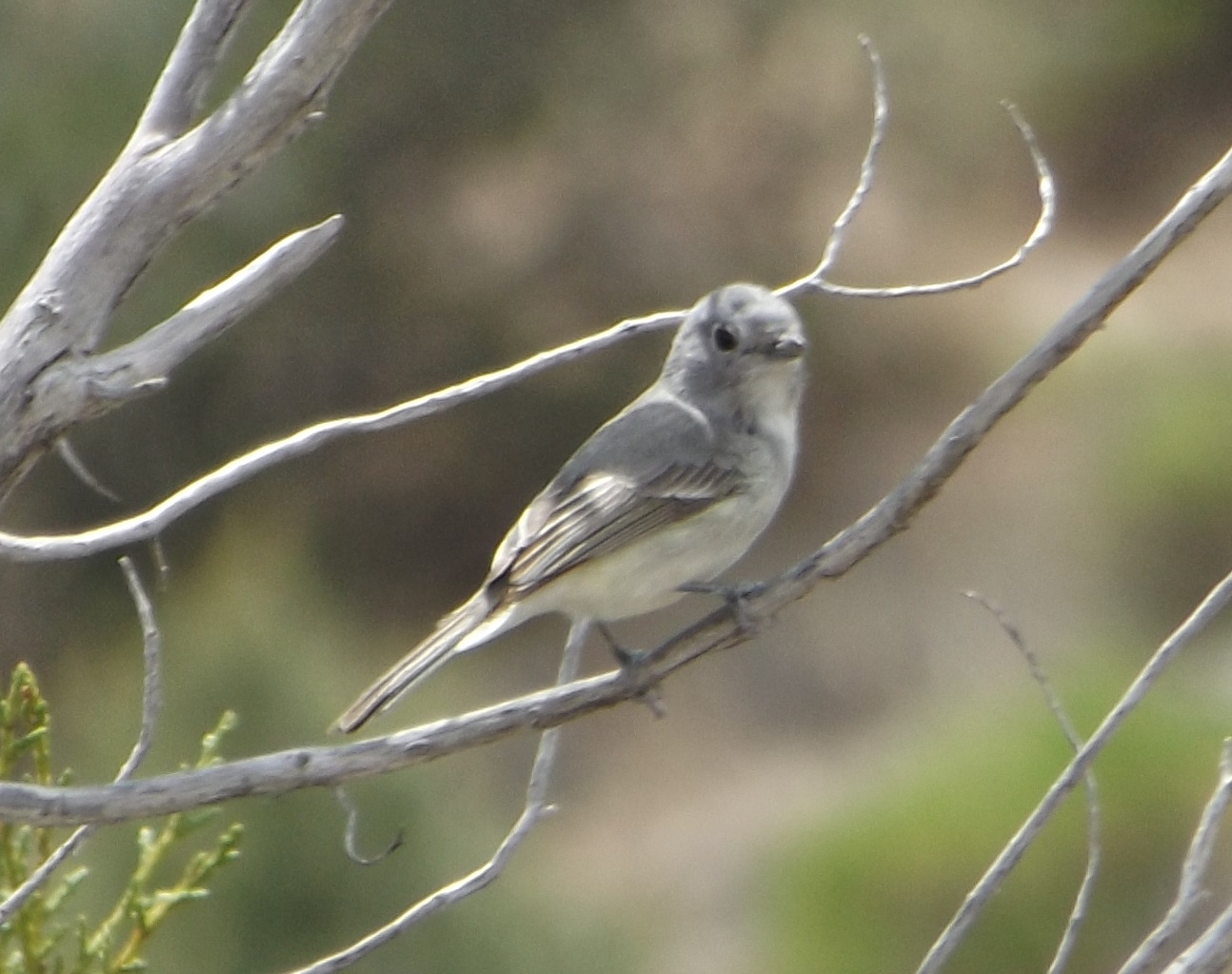
When Tommy found out that I still needed Gray Vireo for my life list, he said that we would stop when he found good habitat. So, we stop, we walk out of the car, Tommy does some pishing, and two Gray Vireos pop out of the brush into plain sight!!! The vireos scolded us harshly while we were taking photos. What a cool bird.
I ended the trip with 8 life birds and 17 new Maricopa Co. life birds! It was incredible. Honestly, I enjoyed the owling most of all. There is something very special about entering a realm foreign to the average person to find the birds that rely upon the dark to survive - the owls and nightjars. Thank you Tommy for driving and guiding us. You are a master of your craft! Thank you Gordon for your excellent company and good nature. I enjoyed meeting you just as much as I enjoyed seeing the birds (if not more so).
Godspeed and good birding,
- Joshua