Hey Readers!
On the 6th of January, I carpooled with
Caleb Strand, Laura Ellis and Susan Fishburn for a day trip to the Seven Springs area which is north of Cave Creek, AZ. In addition to searching for a few previously reported rarities (namely Hooded Warbler and Pacific Wren), we wanted to check out the semidesert grasslands north of Seven Springs on both the Maricopa and Yavapai county sides. We were hoping to find wintering Grasshopper Sparrows. After enjoying some donuts early in the morning, we drove east and north into the higher country.
 |
| One of our first birds of the day were American Robins at Seven Springs Recreation Area |
Heading north past Seven Springs Recreation Area, we entered some fairly healthy semidesert grasslands which boasted good numbers of Western Meadowlarks and sparrows (mainly Chipping, Black-throated, White-crowned and Vesper Sparrows along with some Dark-eyed Juncos).
 |
| One of many young White-crowned Sparrows we encountered. |
 |
| A Vesper Sparrow. Note the white eyering and white outer tail feathers. |
 |
| These grasslands in Maricopa County just south of the Yavapai County line are quite extensive... |
In addition to sparrows and meadowlarks, the grasslands contained many species that are typical of both Sonoran Desert and mid-elevation shrublands including Gambel's Quail, a Ladder-backed Woodpecker, Loggerhead Shrikes, Woodhouse's Scrub Jay, Bushtits, Rock, Bewick's and Cactus Wrens, Western Bluebirds and a calling Crissal Thrasher. From here, we headed back to the Seven Springs area in order to find our main targets of the trip. We made a few quick stops along the way which yielded some very nice birds...
 |
| Our only Sage Thrasher of the day. They can be very photogenic! |
 |
| Interestingly, Gila Woodpeckers were common here. |
Other species of interest here included a Cooper's Hawk, Belted Kingfisher, a Hutton's Vireo, a flock of Cedar Waxwings and Rufous-crowned Sparrows. Further down the road, we made a stop and were surprised to find a Black-chinned Sparrow which is an uncommon wintering bird in Maricopa County. Also, I had two Maricopa County life birds at this stop; Mountain Bluebirds and a Townsend's Solitaire!
 |
| The Townsend's Solitaire; an odd thrush. |
Once at Seven Springs Wash (which is where the Pacific Wren and Hooded Warbler were reported), we geared up for a 3 hour search... Once in the wash, there wasn't a lot of bird activity apart from some Gila Woodpeckers and Bridled titmice that were calling from the trees. We searched long and hard for the warbler and wren without success for nearly 2 hours. Then we started hearing an unusual call coming from upstream. In came the Hooded Warbler! In a flurry of yellow, it whizzed past into some cattails at the stream's edge. Then, it briefly landed in some grass but flew just as I was about to take its picture. What a cool lifer!
 |
| The Hooded Warbler... |
 |
| A Lincoln's Sparrow |
 |
| Another Townsend's Solitaire |
 |
| I bet that Caleb wishes birding could be this comfortable all the time! |
After failing to relocate the Hooded warbler after searching for a while, we decided to move on to our next stop. Traveling north into Yavapai County's grasslands, we noted some interesting species. A distant Sharp-shinned Hawk, flock of Bushtits, good numbers of Canyon Towhees and a Northern Cardinal were the best species apart from one very interesting bird...
 |
| A possible "Timberline" Brewer's Sparrow; a subspecies which nests in the far north but could potentially winter here. |
 |
| The distinct gray nape and contrasty features are good field marks for the subspecies although we are not entirely positive of its ID. |
 |
| A Yavapai County Cactus Wren |
 |
| Some potential Native American petroglyphs on a rock where we were birding... |
 |
| A Western Meadowlark |
While birding these grasslands, meadowlarks started passing through from the Maricopa County side. Two of these were confirmed by voice to be Eastern Meadowlarks! What a great Yavapai County addition. Oh wait... Both of them were observed as they flew in from Maricopa County! Score for Maricopa!
After enjoying the grasslands, we headed back into Maricopa County to Lower Camp Creek: a mid-elevation riparian area where a Rufous-backed Robin had been reported a week prior. One of the first I saw was yet another Black-chinned Sparrow! This area must be good for them in winter... Soon after, we picked out a Hutton's Vireo and Bridled Titmouse in the trees in the canyon below our trail.
 |
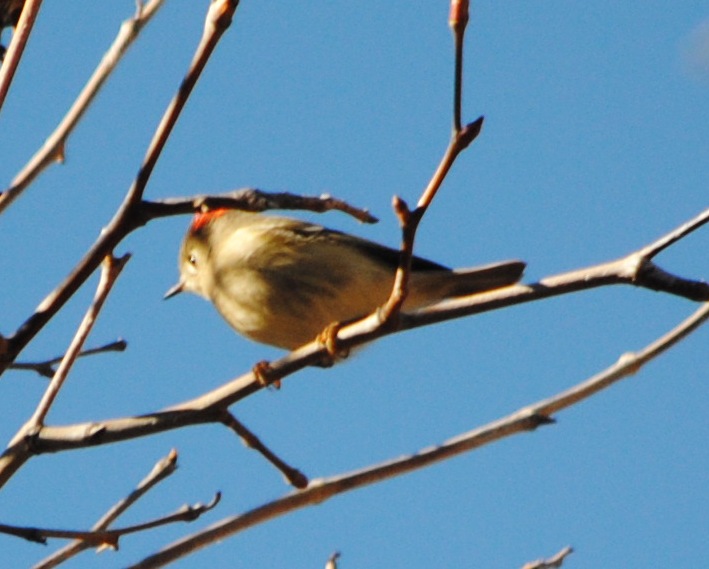
| The Hutton's Vireo; differentiated from Ruby-crowned Kinglet by its broken eyering and thicker, hooked bill. |
 |
| A male Ruby-crowned Kinglet flaring its crown! |
 |
| One of nearly a dozen Hermit Thrsuhes we encountered. |
 |
| A Northern Mockingbird |
 |
| An odd place for a shrine if you ask me... |
Although bird activity was dying because of how late it was getting, we did have some good species. A Black Phoebe, Plumbeous Vireo, Canyon Wrens and Orange-crowned Warbler were good birds.
 |
| My last photo of the day; a Rock Wren in appropriate habitat. |
Overall, our day had been great fun. We enjoyed an assortment of birds that we don't usual see everyday; the birds of the mid-elevations and semi-desert grasslands. I had one life bird: the Hooded Warbler as well as three Maricopa County life birds: Mountain Bluebird, Townsend's Solitaire and Eastern Meadowlark!
Before I end this post, I want to share something that really meant a lot to me: Caleb decided to give me his Nikon D3000 with its 55-300 mm lens at the beginning of the trip. I was absolutely blown away and at first and tried to ask him to sell it to me instead, but he insisted on giving it to me. All of the photos in this post were taken by me using Caleb's camera with the exception of the photo of the camera which was taken by my phone! I am so appreciative of this gift and I will have to start taking some good shots! I gave Caleb my old Fujifilm point-and-shoot so he could at least be able to document rarities while he's saving up for a new DSLR.
Godspeed and good birding to you all,
- Joshua