Saturday, July 9, 2016

Plan For The Best, Expect The Worst

Hey Readers!


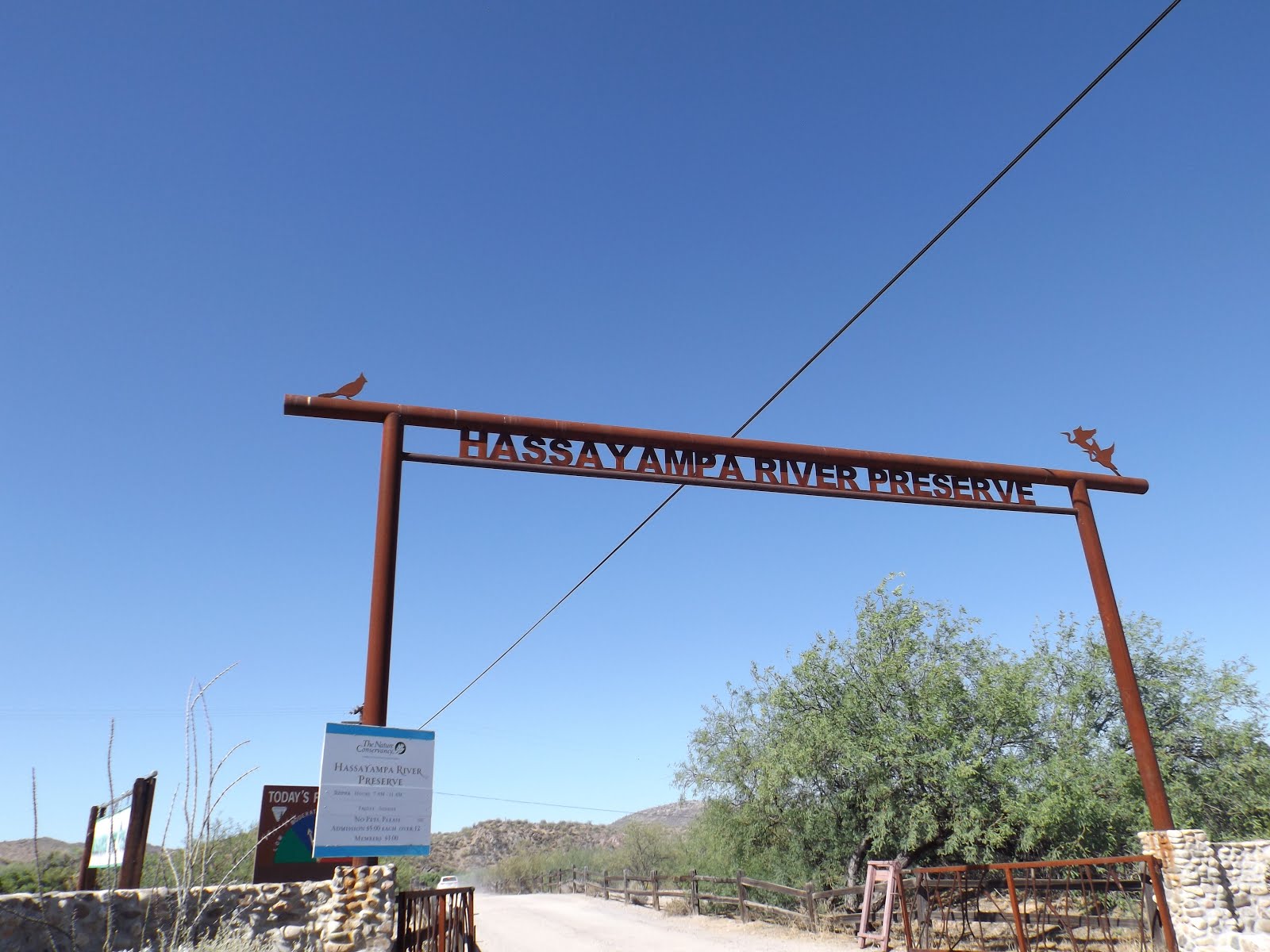
You may recall that I left the Hassayampa River Preserve early to attend an Audubon Society volunteer orientation.  This meeting was held at the Nina Mason Pulliam Audubon Center which is located along the Salt River near the Rio Salado area.  After the meeting, a couple of cool non-birders asked me to guide them on a bird walk on the premises.  Of course I wanted to share with them my love for birding, so we headed out after the meeting...

A Loggerhead Shrike came in for a short period and wowed us with some good looks.  The shrike was a new bird for the two wildlife enthusiasts I was guiding.


This particular Audubon Center has engaged in a Burrowing Owl reintroduction program for some time and the charming little BUOW is a kind of mascot for the center as this mural under a nearby bridge shows.


This female Redhead was flagged as rare on eBird

We also had a nice selection of swallows flying over the riparian area.  We had Northern Rough-winged, Violet-green, Barn, and Cliff Swallows in one area.  Green Herons also moved around quite a bit trying to find good spots to roost.  Most of the birds we encountered were typical desert species such as Gambel's Quail, Greater Roadrunner, Ash-throated Flycatcher, Verdin, Black-tailed Gnatcatcher, Curve-billed Thrasher, and Abert's Towhee.  Some Black Phoebes and Mourning Doves had also nested at the center.  After a nice walk, I said goodbye to the two meeting attendees and departed for home.   

This Widow Skimmer at the Audubon Center certainly didn't disappoint!

Three days after Hassayampa, my Mom decided to take me out birding!  (Thanks Mom!)  Since I needed a lot of birds at the Tres Rios Wetlands and because it wasn't a treacherous location to navigate, it seemed to be our best option.  We had a bit of a late start, but I was out birding by 7:30.  I had high hopes of finding the continuing male Painted Bunting along with a host of other potential Maricopa lifers.  

While walking along the main trail, I had to reacquaint myself with the Red-winged Blackbird's many vocalizations.  When I am out birding, I always watch where I am walking.  Sometimes I find something interesting - like this Iron Cross Blister Beetle!


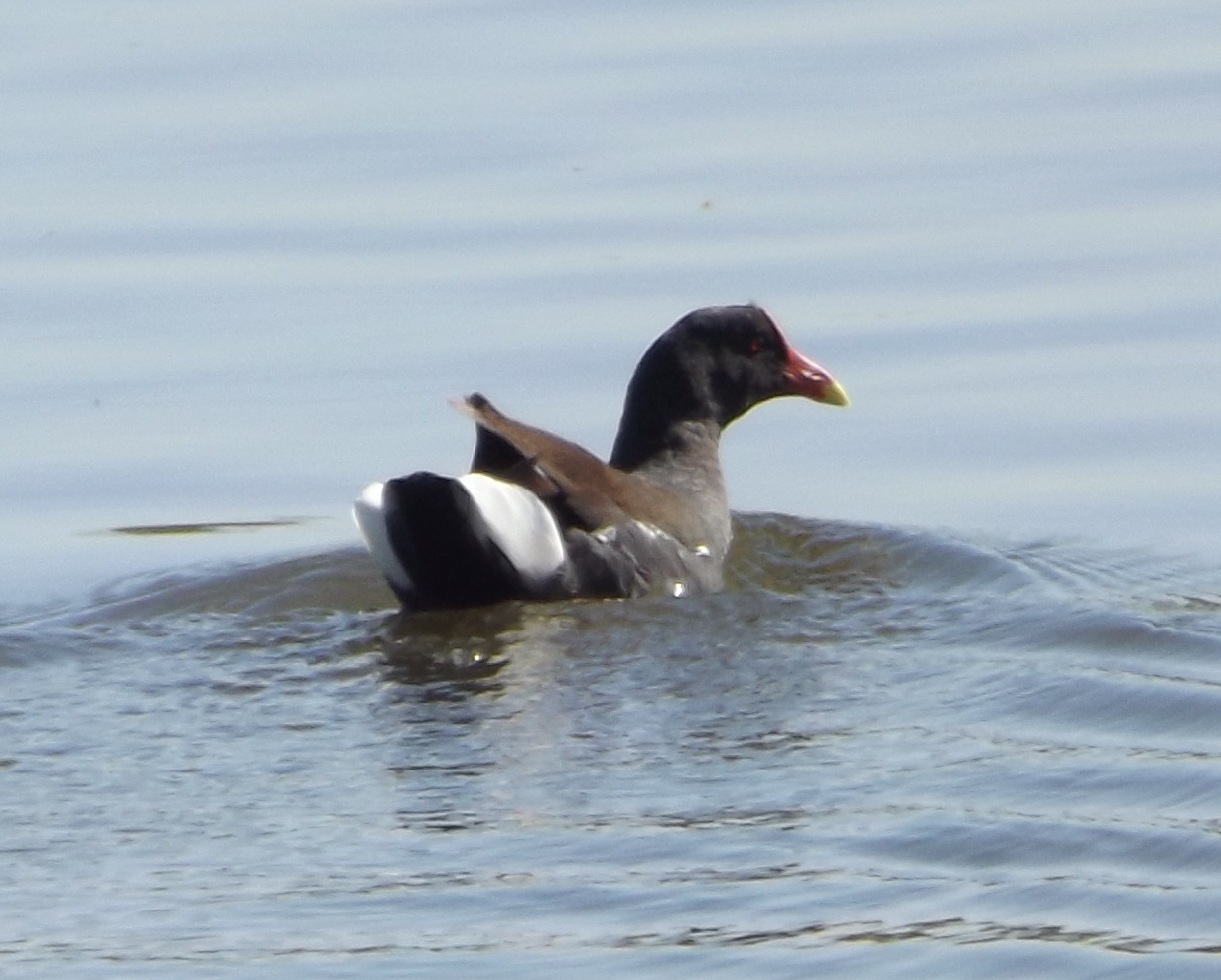
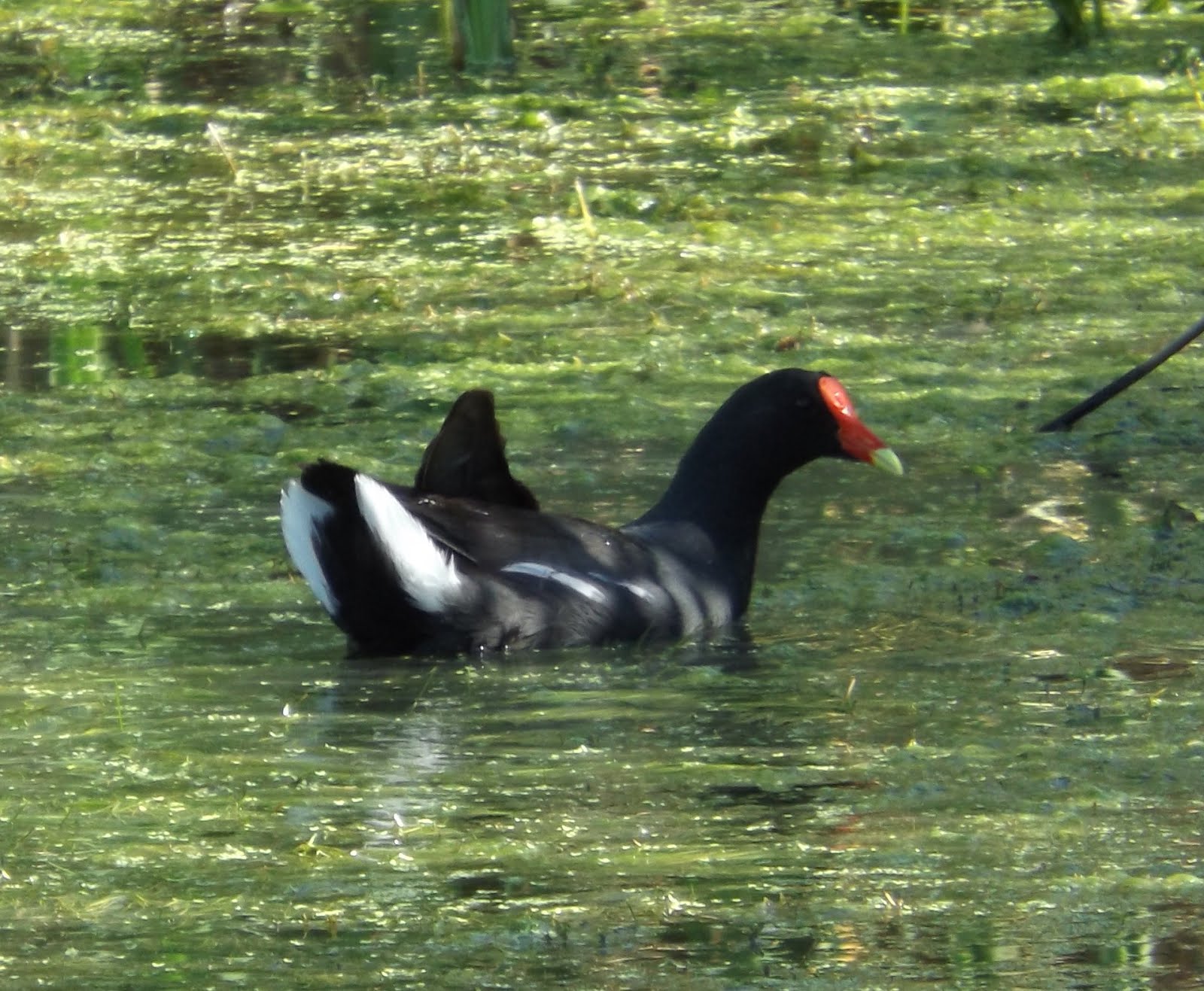
As we continued walking, we found some Common Gallinules which were scattered across Tres Rios's many ponds.


Other good birds that crossed paths with us included a Least Bittern, a singing male Western Tanager, a Black-headed Grosbeak, a Lazuli Bunting, and quite interestingly, two Zone-tailed Hawks!


Some of the most abundant birds here included the Cliff Swallows, White-winged Doves, and Eurasian Collared Doves.  The doves flew overhead in massive lines of hundreds of birds which reminded me of a WW2 aerial assualt!

Even after four hours of birding, I didn't find any of the birds that I needed.  I was pretty bummed, but I still enjoyed everything that I did get to see!

Around noon, we left Tres Rios to try to get some some Maricopa lifers at the Glendale Recharge Ponds.  I was hoping to find the previously reported Indigo Bunting most of all.  I began scanning the ponds and picked out some Cinnamon Teal, a Lesser Scaup, some American Wigeons, an Eared Grebe, a Redhead, several White-faced Ibis, a few American Avocets. and one Greater Yellowlegs.  A few of those birds were late rarities.


After thoroughly examining the basins, I headed on over to the bike path that parallels a stretch of riparian habitat.  I found two Bald Eagles and a calling Pacific-slope Flycatcher there!


But alas, no new Maricopa county birds crossed my path.  Although the day was a failure in some respects, I still thoroughly enjoyed what I did find.  From seeing a Least Bittern's buffy covert feathers for the first time to hearing Red-winged Blackbirds give calls I hadn't heard before, how could I say that I learned nothing?  I will always be a student.  I will never stop learning.


Godspeed, good birding, and keep learning,

- Joshua

Saturday, July 2, 2016

In the Thick of It

Hey Readers!


Having recently returned from an epic out-of-county birding trip, I was beginning to miss my favorite county, Maricopa.  A great chance to add a bunch of new birds to my MC list came up when a Thick-billed Kingbird was reported at the Hassayampa River Preserve!  The TBKI is pretty much one of Arizona's Southeastern Specialties, so having it this far north was pretty wild!  Saturday the 21st of May seemed to be my best opportunity for the bird.  Figuring that Tommy D (the King of Maricopa) would also want to chase this bird, I sent him a text asking if he would be interested in joining forces Saturday morning.  He said he was already planning to be there with Gordon Karre and that I was welcome to join them.

I hadn't birded any of Maricopa County's riparian areas up until this point, so you can imagine that I needed a lot of birds!  My Dad and I arrived at the US 60 Rest Area at 6:30 am to bird a while before the Hassayampa River Preserve opened.  I quickly spotted a male Summer Tanager - a county lifer for me!  Other birds I noticed here included a few Ladder-backed Woodpeckers, a couple Vermilion Flycatchers, two Ash-throated Flycatchers, a single Brown-crested Flycatcher, and a Lucy's Warbler.


This Ornate Tree Lizard was also a nice catch at the rest stop

After wandering around the rest stop's parking lot for 10 minutes or so, I noticed that Tommy had pulled up also.  Makes sense that he too would be checking out this area beforehand.  We drove into the preserve after talking for a little while at the rest stop.        


In the preserve's parking lot, Tommy, my Dad, and I met up with Gordon.  He had a nice custom license plate for his car that read "Elf Owl".  A Yellow-breasted Chat sang loudly from a mesquite right in the front of cars.  the chat was yet another new Maricopa bird for me.  Before paying our entrance fee, we met up with Dale Clark, Babs Buck, and a few of her friends who were also searching for the kingbird.  The preserve's building had some nice exhibits that I would have more thoroughly examined had I not been so preoccupied with finding the kingbird.  Not only was I hoping for the Thick-billed Kingbird, but I was also excited to find the Tropical Kingbirds and Gray Hawks which reach their northernmost range at Hassayampa.


Once we paid the entrance fee, Gordon, Tommy, Dale, my Dad, and I set off towards the Mesquite Meander Trail to search for the kingbird.  On the way, I noticed the call of a Pacific-slope Flycatcher which was another county lifer!  Migrants such as Western Wood Pewees, Hammond's Flycatchers, Yellow Warblers, Wilson's Warblers, and Lazuli Buntings were also detected.  After stopping mid way along the Mesquite Meander Trail, we quickly picked out some Tropical Kingbirds - a lifer for me!


Then, I noticed a large flycatcher in a nearby snag.  I paused for a moment, thought about what else it could be, and then called out "I think I've got it over here!"  Tommy and the other birders rushed over and gazed in wonder at their first Thick-billed Kingbird for Maricopa County!  Tommy got some insurance photos and then gave me a fist bump.  I could only hope to find as many birds as he has in this county!  We wanted to say a lot, but said nothing.  We just watched this massive flycatcher up on its perch as it called very loudly.


This Bullock's Oriole also made a brief appearance for us

After a few minutes, the kingbird flew northward towards some dense mesquites.  Tommy and I went off trail briefly to attempt to relocate the bird.  We found nothing apart from a Blue Grosbeak's metallic call.  That Blue Grosbeak was my first for the county.  Since this particular location was the kingbird's go-to spot, we decided to camp out for a while hoping it would come back.  The trail was mostly quiet.  A cardinal sang occasionally.  A pair of Western Tanagers flew overhead.  Some White-throated Swifts passed over us high in the sky.  I started walking around the area a little and got excited when a large flycatcher popped into a bush.  It was a Brown-crested Flycatcher though.  I walked around a little more and saw something pass me overhead.  It was the Thick-billed Kingbird!  It vanished into some cottonwoods.  While we were all searching the cottonwoods, Gordon pointed out the bird towards the top of one of the trees!


The group taking in some awesome views of the TBKI

After 10 minutes or so of watching, we decided to leave the kingbird alone and move on in search of other birds.  We stopped to check out a Warbling Vireo when Gordon and I heard a Gray Hawk's peacock-like cry!  The GRHA was a lifer for me, although a heard-only.  Eventually, we reached the small Palm Lake where many cool birds such as Swainson's Thrushes and Wood Ducks had been reported recently.  We had Red-winged Blackbirds and a Common Yellowthroat there.  We stopped by a dense tangle of willows to look and listen for Willow Flycatchers.  fitz-bew.  fitz-bew.  The endangered Southwestern Willow Flycatcher called again faintly, but distinctly.  What a neat call - and a neat lifer!

By this time, I was pushing it to be on time for an Audubon volunteer orientation, so I decided to take off early.  Right as I was shaking hands with the birders to say goodbye, my Maricopa lifer Canyon Wren sang in the distance!  What a wonderful song.  On the way out, I stopped to check the hummingbird feeders for the Broad-billed Hummingbirds that had been reported earlier.  After 5 minutes of grueling anticipation, a male showed up and chased all the other hummers away!  Yet another score for Maricopa County!


In summary, I had the following lifers at Hassayampa:  1. Tropical Kingbird  2. Thick-billed Kingbird  3. Gray Hawk  4. Willow Flycatcher

My Maricopa lifers were: 1. Summer Tanager  2. Yellow-breasted Chat  3. Pacific-slope Flycatcher  4. Tropical Kingbird  5. Thick-billed Kingbird  6. Blue Grosbeak  7. Gray Hawk  8. Willow Flycatcher  9. Canyon Wren  10. Broad-billed Hummingbird


Godspeed and good birding,

- Joshua


Friday, July 1, 2016

Birding's Biggest Day: The Untold Story

Hey Readers!


My last post about Birding's Biggest Day was almost entirely focused on birds.  But do you really think birds were all we saw in over 24 hours of exploring?  Nope.  We had some excellent mammals, reptiles, amphibians, and invertebrates to go along with our bird list.  And those creatures are what this sequel is all about.

So, do you remember how Caleb and I scouted the arboretum before the official count?  That was a very active time for the lizards.  Somewhere around 4:30 pm, we reached Ayer Lake and enjoyed seeing several Red-eared Sliders that were basking out in the sun.


My first reptilian lifer of the trip was the Greater Earless Lizard.  These were possibly the most abundant lizard at the arboretum except for maybe the Desert Spiny Lizards.


A drab Greater Earless Lizard

This one knows it has a fiesta on its back!

The only Common Side-blotched Lizard I recall seeing

My lifer Ornate Tree Lizard...on a rock?!

Ornate Tree Lizard or Long-tailed Brush Lizard?  I don't know yet...

A nice Camel Cricket (Ceuthophilus sp.)

A massive wolf spider (likely Hogna carolinensis)

Our sole amphibian species of the trip - a Lowlands Leopard Frog at Ayer Lake

A large and solitary carpenter ant that wandered about

A Selenops Spider on the high trail


A fine specimen of an Arizona Fishhook Cactus.

A female Greater Earless Lizard

A large adult Desert Spiny Lizard.  Note its bluish green tail!

Can you guess what it is???

...A venomous Western Diamond-backed Rattlesnake 

A young Desert Spiny Lizard

Remember the Sonoran Whipsnake from my previous post?


It sure had beautiful orange eyes.

And a striking double stripe running along its side

Another Desert Spiny Lizard

An Arizona Powdered Skipper


An Arizona Giant Centipede we found under a rock


An interesting stretch of the Queen Creek


A mantis that we observed hunting while looking for Elf  Owls


A scorpion I am still trying to ID

A Bloodsucking Conenose (Kissing Bug)

These ants were carrying purple flower petals back to their hill!


Congratulations on getting past my extensive gallery of photos!  I hope you enjoyed them.  Since I have shown you all of the herps and invertebrates of the expedition, I wanted to share the mammals of the trip as well. Because I was unable to photograph most of the mammals I encountered, I will simply tell some stories of my observations starting at the beginning of the trip...
         
Upon embarking on our scouting trek on Friday afternoon, we encountered some Harris's Antelope Squirrels and Rock Squirrels.  A few Desert Cottontails also crossed paths with us.


A Harris's Antelope Squirrel

While birding Ayer Lake, I noticed something in the reeds below.  When I investigated, it turned out to be an Arizona Cotton Rat - a species that relies upon dense cover near water to survive.  Moving on from the lake, we found a single Cliff Chipmunk in a rocky area.  By the time we arrived at the Queen Creek riparian area, the sun was quickly setting and we had a full night of owling to look forward to.  Caleb noticed some very small bats which fluttered like a moth in flight.  Western Pipistrelles.  He picked up a small pebble a threw up into the air and the bats dove at it thinking it was a tasty moth.  It is absolutely incredible that the bats' echolocation was so acute as to detect the pebble Caleb threw!  I also heard some bats chirping at different points during the night.  I have no clue as to what they were.

Past midnight, we hiked along the steep and rocky High Trail and found two very cool lifer mammals!  The first was a Brush Mouse which quickly darted back into a mess of branches and other debris.  True to name!  Maybe 20 minutes later, Caleb and I saw a  Rock Pocket Mouse which frantically entered its burrow when we shined the light on it.

Back down into more typical desert habitat, a Bailey's Pocket Mouse scurried off the trail and out of view.  Another mammalian lifer came in the form of a Western White-throated Woodrat which was trying to slink off into a bush incognito.  After peering into the bush awhile with my flashlight, I relocated the woodrat - though obstructed by many branches.  It didn't stay put long enough for any photos.
That day brought us many more Harris's Antelope Squirrels, Rock Squirrels, Cliff Chipmunks, and Desert Cottontails than yesterday had.  Around 10 pm, we switched from owling to searching for birds on their night roosts.  It was kind of unnerving to find several Western White-throated Woodrats climbing on the branches of the trees that the birds were sleeping in.  They must have been hunting those birds.

I hope all of this info will help out any herp-lovers or mammal watchers that plan on visiting the Boyce Thompson Arboretum in the future!  I will leave you all with my non-bird totals from both Friday and Saturday:

1 Amphibian:

2 Lowlands Leopard Frog

8 Reptiles:  

7+ Desert Spiny Lizard
3 Ornate Tree Lizard
1 Unidentified Urosaurus sp.
4 + Greater Earless Lizard
1 Common Side-blotched Lizard
10+ Sonoran Tiger Whiptail
3+ Red-eared Slider
1 Sonoran Whipsnake
1 Western Diamond-backed Rattlesnake

10 Mammals: 

1 Bailey's Pocket Mouse
1 Rock Pocket Mouse
7+ Harris's Antelope Squirrel
6+ Rock Squirrel
6 Cliff Chipmunk
4 Western White-throated Woodrat
1 Brush Mouse
1 Arizona Cotton Rat
7+ Desert Cottontail
3+ Western Pipistrelle

8 Notable Invertebrates:
                
1 Arizona Giant Centipede
1 Carolina Wolf Spider
1 Selenops Spider
1 Desert Hairy/Stripe-tailed Scorpion
1 Bloodsucking Conenose
1 Unidentified Mantid
2 Camel Cricket
1 Arizona Powdered Skipper


Godspeed and good birding, herping, and mammalwatching,
- Joshua